The constitutional process has two related but distinct purposes.
The first is continuity: ensuring that Alberta has lawful, democratic and functioning government throughout the transition and on Day 1 of independence.
The second is permanent constitutional design: allowing Albertans to decide, through a separate democratic process, what the long-term Constitution and institutions of an independent Alberta should be.
These two tasks should not be confused. Alberta does not need to design an entirely new system of government before it can make an orderly transition to independence. The existing Government of Alberta structure and institutions provide the practical bridge, while permanent constitutional choices are reserved for the separate Constitutional Track.
Alberta already has the core institutions of a functioning government: an elected Legislative Assembly, Premier and Cabinet, ministries, a budget and treasury system, a professional public service and courts. Those institutions presently exercise authority within Alberta's provincial jurisdiction. What Alberta does not currently possess is sovereign authority over matters that remain within federal jurisdiction or the full constitutional authority of an independent country.
For that reason, this plan separates the three-phase independence transition from the permanent constitutional development track.
Phase 1 is the period of preparation before the proposed 2027 independence referendum. Alberta remains a province of Canada during this period.
Phase 2 begins only if Albertans provide a successful independence mandate in a 2027 independence referendum and is focused on negotiations, constitutional implementation and operational readiness for Day 1 of independence.
Phase 3 begins on the day of independence and is concerned with stabilizing the new arrangements and completing the remaining transition work.
The Constitutional Track answers a different question: what permanent system of government and constitutional rules should Albertans ultimately choose for their country?
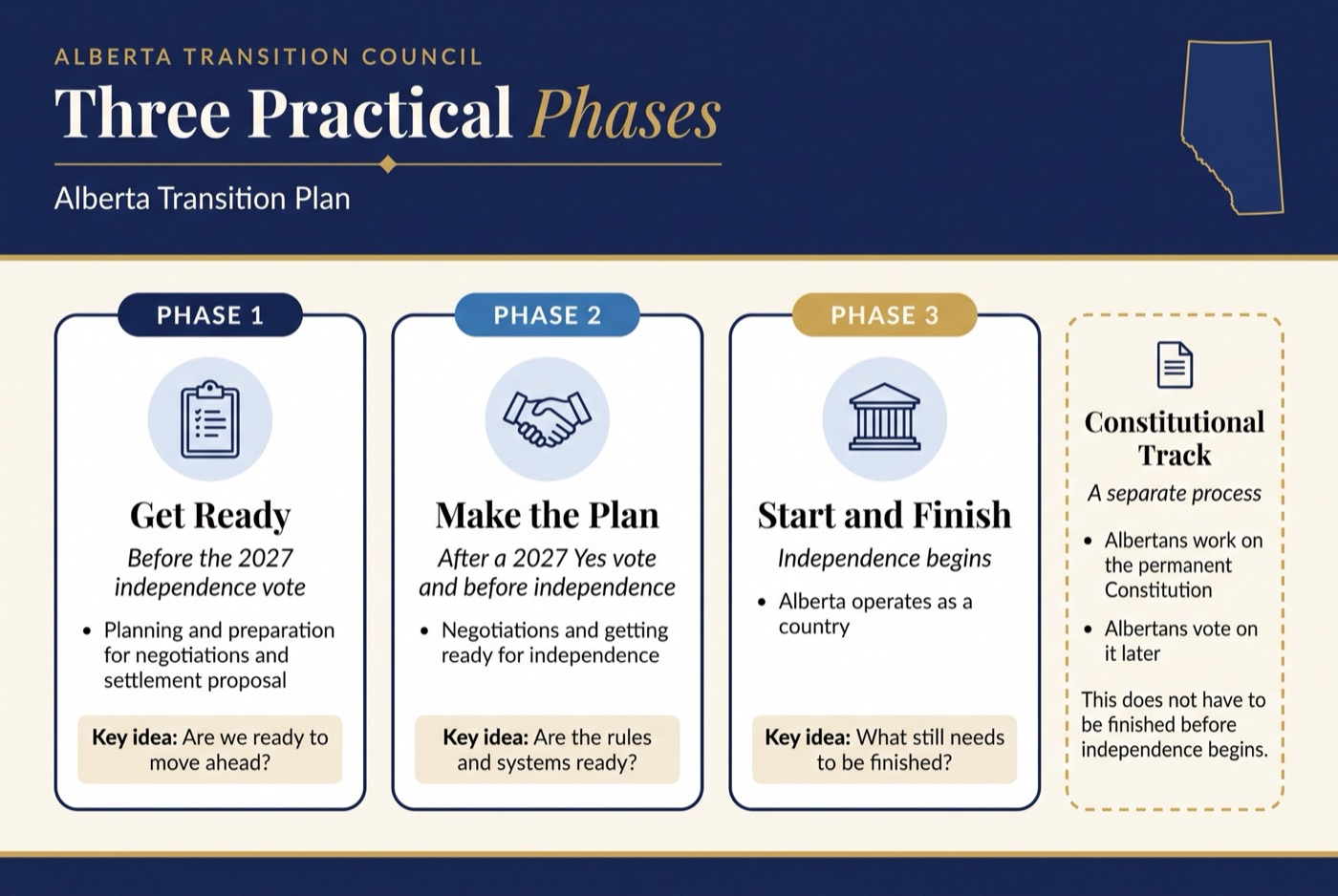
The existing Government of Alberta institutions provides the bridge between these processes. A successful independence referendum would not instantly create a new legislature, court system or permanent constitution. During Phases 1 and 2, the existing Legislature, Premier and Cabinet, ministries, public service and courts continue while the transition is prepared and negotiated. On Day 1 of independence, those institutions would continue under the constitutional and legal arrangements implementing independence and would assume the additional responsibilities of an independent country.
There would therefore be no constitutional vacuum on Day 1. The immediate task is to ensure Alberta’s existing institutions have clear and lawful authority to continue functioning without interruption, while the permanent constitutional structure is considered through the separate Constitutional Track.
The development of a permanent constitution would then proceed on its own track from the other aspects of the independence process. Constitutional research and public discussion can occur during Phases 1 and 2, but the independence referendum would not itself approve or bring into force a permanent constitution following a successful independence referendum in 2027, a Constitutional Conference or similar public process would address longer-term questions such as the permanent structure of the executive and legislature, the judicial system, rights protections, amendment procedures and other enduring institutions.
The resulting constitution would then be submitted to Albertans for ratification. The permanent constitution would come into force once it had been approved by Albertans and the institutions required to implement it were read (the “Constitutional Commencement”). This would not necessarily occur on Day 1 of independence.
The distinction can be stated simply:
Day 1 of independence determines when Alberta becomes an independent country. The permanent constitution takes effect later, once Albertans have approved it and Alberta is ready to implement it.
The two processes may overlap, but they operate on different clocks.
The Independence Transition Track
This process determines when Alberta becomes and independent country and prepares Alberta for that transition. It includes:
The October 2026 referendum
Activation of the government’s Transition Research Task Force
The proposed spring 2027 independence referendum
Independence negotiations
The September 20 Negotiation Decision Point
The October 18 provincial election
Day 1 of independence.
The Constitutional Track
This process allows Albertans to consider, develop and approve the permanent constitutional system that would govern the new country over the long term. Unlike the independence transition, this process does not have fixed dates, but would operate on an approximately twelve-month timeline once commenced. It includes:
Constitutional research and public consultation
The Constitutional Conference.
A referendum allowing Albertans to approve the proposed Constitution
The Constitutional Commencement being the date on which the approved Constitution takes effect and once Alberta is ready to implement it.
The white paper recommends that during the interim constitutional period, the Government of Alberta continues as the functioning government. It is not replaced by a second provisional or transition government. Individual officeholders may change through elections, but the institutions of government continue.
The principal change is the scope and source of their lawful authority. Functions presently exercised by Canadian institutions would be transferred, continued temporarily, replaced or assumed by Alberta as provided by the transition arrangements.
Permanent constitutional choices are deliberately left for the Constitutional Track.
2.1 Interim Constitutional Continuity Arrangements
A successful independence referendum in 2027 would provide the democratic mandate to proceed toward independence. It would not itself bring permanent constitutional institutions into existence.
The same Government of Alberta should therefore continue through negotiations, the ordinary provincial electoral process, Day 1 independence and the interim constitutional period. The Legislative Assembly, Premier and Executive Council, ministries and public administration continue as institutions, although officeholders may change through the ordinary democratic and election process.
This approach avoids unnecessarily creating a second provisional government alongside the government Albertans already have. It also provides a clear chain of democratic accountability throughout the transition.
The purpose of the interim arrangements is not to decide Alberta's permanent constitutional future. The purpose is to ensure that government remains lawful, stable and functional while Albertans consider that future separately.
2.2 Interim Constitutional Framework
Before Day 1 independence, Alberta should have a clearly defined interim constitutional framework ready to take effect as part of the legal implementation of independence.
That framework should be deliberately limited to what is necessary for continuity and lawful government. Among other things, it should:
continue the Legislative Assembly, Premier and Executive Council, ministries and public administration;
preserve the independence and functioning of the courts;
maintain existing laws, legal rights, contracts, proceedings and governmental authorities unless lawfully changed;
preserve lawful appropriations, taxation and public-money authority;
provide express protection and non-derogation for Aboriginal and treaty rights;
provide authority for the temporary continuation or reception of federal laws that cannot safely disappear on Day 1 of independence;
establish the interim source and allocation of Alberta's sovereign legislative and executive authority; and
establish the process by which Alberta's permanent constitution will be developed and submitted to Albertans.
The interim framework should answer the questions that must be answered for Day 1 of independence, while deliberately avoiding permanent choices that do not need to be made during the transition.
For example:
| Interim constitutional question | Permanent constitutional question |
|---|---|
| Who exercises executive authority on Day 1? | What should Alberta's permanent executive model be? |
| How does the existing Legislature continue? | What should the permanent legislature look like? |
| How do the courts retain lawful authority? | What should the permanent judicial structure be? |
| How are existing rights protected during transition? | What permanent constitutional rights framework should Alberta adopt? |
| How are laws and public finances continued? | What permanent fiscal or constitutional rules should apply? |
| How is government kept accountable during transition? | What permanent amendment and accountability mechanisms should the Constitution contain? |
Edmonton should continue as the seat of the Government of Alberta throughout the interim constitutional period unless and until Albertans decide otherwise through the permanent constitutional process.
2.3 The Constitutional Track
The Constitutional Track should address matters such as:
the permanent structure of the executive;
the structure and powers of the legislature;
the permanent court and judicial-appointment system;
constitutional protection of rights and freedoms;
Aboriginal and treaty rights;
the relationship between provincial or national institutions and municipalities;
public-finance and accountability rules;
mechanisms for constitutional amendment; and
any other permanent institutions or constitutional offices Albertans decide should form part of the new constitutional order.
Preparatory research, comparative constitutional analysis and public education can begin during Phase 1 and continue during Phase 2. Formal constitutional deliberations should begin only after a successful independence referendum and once there is sufficient clarity about the transition for participants to make informed choices about Alberta's permanent institutions.
The preferred approach is therefore not to force a permanent Constitution onto the same timetable as Day 1 independence. Formal deliberations may begin during Phase 2 if the legal and political framework is sufficiently settled, or they may continue into Phase 3. The important point is that the constitutional process should not delay Day 1 independence merely because every long-term constitutional question has not yet been resolved.
Likewise, Day 1 independence should not force the constitutional process to finish prematurely.
This plan contemplates that, once commenced, a Constitutional Conference would operate on its an approximately twelve-month timetable. The Constitutional Conference would develop a proposed Constitution for Albertans to approve in a referendum. The Constitution would take into effect on the Constitutional Commencement date, once institutions are ready to assume authority.
None of those long-term choices should be treated as having been approved merely because Albertans voted for independence.
2.4 Allocation of Legislative and Executive Authority
During the transition, a clear and understandable chain of authority is key.
The existing Legislative Assembly, Premier and Executive Council should therefore continue as the Government of Alberta across Day 1 independence and throughout the interim constitutional period, exercising the additional sovereign authority provided by the constitutional implementation arrangements and Alberta transition legislation.
The October 2027 provincial election would remain an ordinary democratic election capable of changing or confirming the Premier, Cabinet or composition of the Legislative Assembly. It would not interrupt the institutional continuity of the Government of Alberta or require negotiations and transition work to begin again.
After Constitutional Commencement, legislative and executive authority would be exercised under the permanent constitution ratified by Albertans and by the institutions constituted under it.
2.5 Continuity of Existing Alberta Law
Alberta's existing statutes, regulations, orders, appropriations and administrative authorities should not lapse merely because Alberta's constitutional status changes.
A general Continuity of Laws Act or equivalent transition legislation should provide that existing Alberta law continues in force unless and until it is lawfully amended or repealed.
This is an important part of the continuity-first approach. Day 1 independence should not require Alberta to rewrite thousands of laws simply because their constitutional setting has changed.
Longer-term legislative reform can occur afterward through the normal democratic process.
2.6 Treatment of Existing Federal Law
Federal laws that presently govern activities in Alberta also cannot simply disappear on Day 1 independence where doing so would leave a legal or regulatory gap.
During Phase 1 and Phase 2, federal statutes and regulations affecting Alberta should therefore be inventoried and classified according to what must happen to them.
Some federal laws may no longer be relevant. Others may be replaced immediately by Alberta legislation. Some may need to be temporarily continued or adapted under Alberta authority until a permanent Alberta regime can be developed.
The objective should be continuity first, redesign later.
Where a federal rule presently provides the legal basis for an important activity—such as banking, aviation, transportation, criminal law, border services, telecommunications or product regulation—the transition plan should identify what legal authority replaces it, who administers it, and what happens if the permanent Alberta regime is not yet ready.
The public should therefore not think of Day 1 independence as the moment when the federal statute book simply disappears. It is better understood as a controlled legal transition in which necessary laws are continued, adapted or replaced in an orderly sequence.
Selected references from white papers
- Supreme Court of Canada: Reference re Secession of Quebec, [1998] 2 S.C.R. 217.
- Government of Canada: Clarity Act, S.C. 2000, c. 26.
- Government of Canada: Constitution Acts, 1867 to 1982.