The central conclusion of this plan is straightforward: an Alberta transition to independence would be complex, but it is capable of being planned, organized and implemented.
Alberta would not be starting from scratch. Most of the institutions, infrastructure, businesses, professional workforces and public services Albertans rely on already exist. The principal transition work is to preserve what already functions, transfer or replace federal responsibilities where required, maintain connections to Canadian and international systems, and establish the limited number of sovereign functions Alberta does not presently need as a province.
28.1 Principal Transition Challenges
The most difficult transition issues are generally not the public services Alberta already delivers. They are the legal, financial and external connections behind those services.
The highest-priority challenges include:
lawful constitutional implementation;
protection of Aboriginal and treaty rights and First Nation-specific arrangements;
access to federal records and data;
taxation, treasury, banking and payment continuity;
pensions and benefits;
citizenship, mobility, borders and customs;
trade and transportation access;
federal assets, liabilities and personnel;
aviation, telecommunications and energy interfaces; and
international recognition and market access.
These matters require early preparation because Alberta cannot control every negotiating or counterpart timeline.
28.2 What Must Be Ready for Day 1
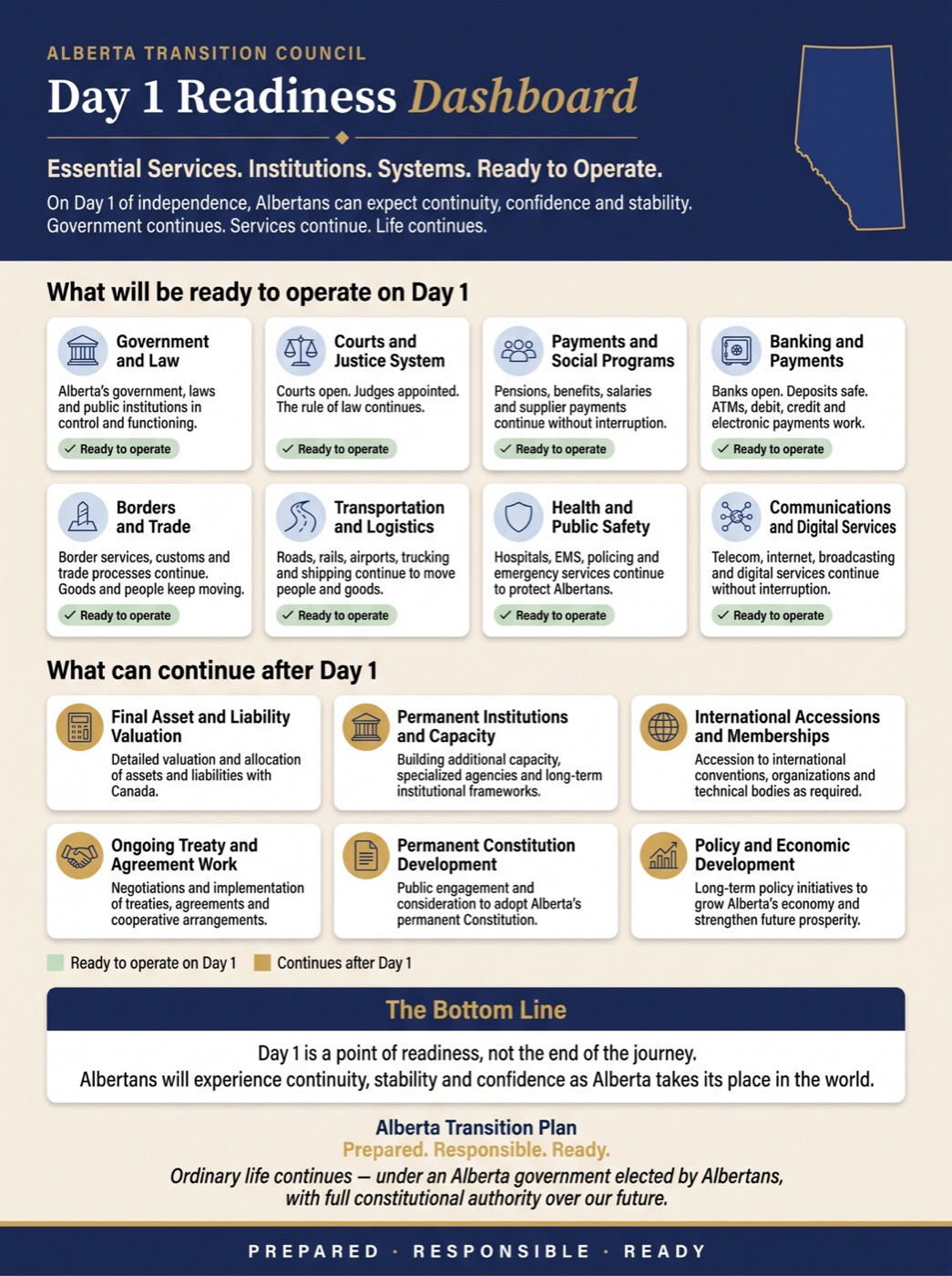
Day 1 of independence should occur only when the legal arrangements necessary for independence are in place and the critical systems needed to keep Alberta functioning are ready.
That does not require every negotiation, asset transfer or long-term policy decision to be completed.
For each essential function, Alberta should be able to answer a few practical questions: Who is responsible? Is the legal authority in place? Are the staff, funding, records and technology ready? Are required external connections operating?
The practical test is whether the first real transaction will work: the pension payment arrives, the bank payment clears, the court order remains enforceable, the truck can cross the border, the aircraft can operate and the hospital can obtain the medicines it needs.
28.3 Work That Can Continue After Day 1 of Independence
Day 1 of independence is the beginning of independence, not the end of every transition activity.
Temporary service agreements can remain in place. Remaining records and assets can be transferred. International arrangements can continue to be completed. New institutions can be refined, and temporary systems can progressively be replaced by permanent ones.
The same principle applies to Alberta’s permanent Constitution. Independence can begin under lawful interim constitutional arrangements while the separate Constitutional Track continues toward a proposed permanent Constitution, ratification by Albertans and Constitutional Commencement.
Overall Finding
The supporting research in the white papers does not suggest that every future outcome can be guaranteed. No transition of this scale could. What the research does demonstrate is that the governmental, legal, economic and operational functions required for an independent Alberta can be identified, assigned, planned, sequenced and tested in advance.
The transition should therefore be understood not as an unknowable leap, but as a substantial and manageable legal, governmental and operational undertaking. Its success would depend on disciplined preparation, lawful implementation, good-faith negotiations, protection of existing rights, credible contingency planning and an unwavering focus on maintaining essential services and economic continuity throughout the transition.
For most Albertans, the clearest measure of a successful transition would be that Day 1 of independence feels remarkably ordinary. Government continues to function. Courts remain open. Pension and benefit payments arrive. Banks operate. Businesses open their doors. Goods move. Transportation, communications and essential public services continue without interruption.
What changes is constitutional authority.
Ordinary life continues—but Alberta becomes responsible for its own future, under a government elected by Albertans and possessing the full constitutional authority of an independent country over its laws, finances, institutions and national decisions.
Selected references from white papers
- Supreme Court of Canada: Reference re Secession of Quebec, [1998] 2 S.C.R. 217.