Alberta exporters currently trade under Canada’s World Trade Organization (WTO) membership and Canadian free-trade agreements. The federal government negotiates those agreements and administers national tariff and trade-remedy rules, while Alberta firms actually produce, sell and ship the goods and services. Most commercial relationships therefore exist independently of the federal negotiating machinery, but their preferred tariff treatment and legal protections may depend on it.
The transition question is not whether Alberta suddenly has no customers. It is whether those customers and customs authorities continue to treat Alberta-origin goods under an acceptable legal framework while permanent arrangements are negotiated.
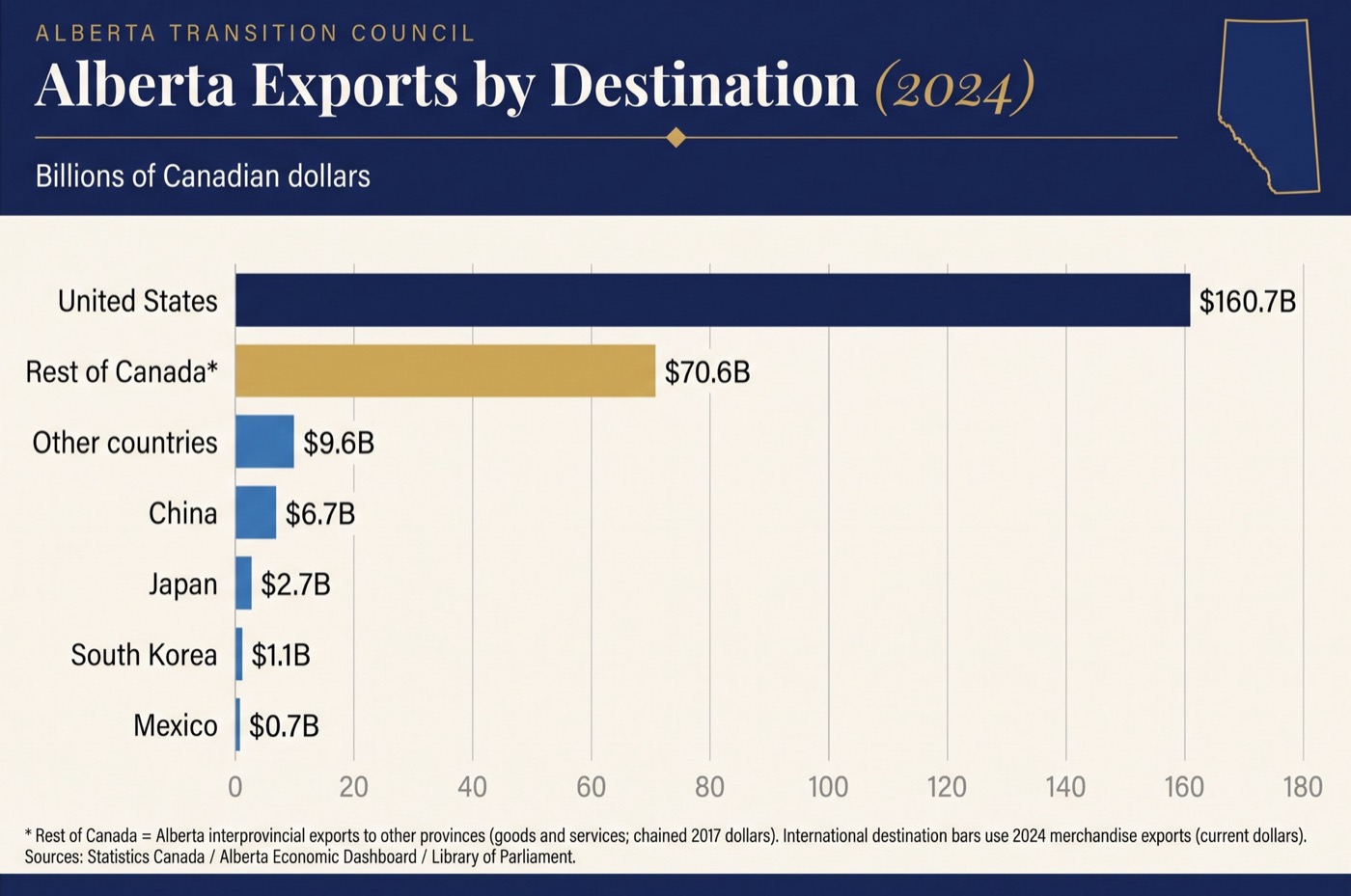
Alberta merchandise export concentration by destination
The World Trade Organization (WTO) and free-trade agreements set rules between governments, but customs agencies and private traders apply those rules shipment by shipment. A tariff is the customs charge applied to imported goods. A rule of origin determines which country a product is treated as coming from for purposes such as preferential tariff treatment. A product may also need a safety, health or technical certificate before a foreign authority will admit it.
For Alberta, the Day 1 objective is not to complete every possible trade negotiation. It is to make the legal route for priority commerce clear enough that a business, customs broker, carrier, bank and foreign border agency know how to process the transaction. Interim bilateral arrangements with Canada and the United States can therefore be more operationally valuable than waiting for a comprehensive long-term agreement. The physical customers, products and supply chains already exist; the government task is to keep their market-access rules usable.
Four trade terms should not be treated as synonyms. A “tariff” is a tax or duty applied to imported goods. “Customs clearance” is the border process that declares, assesses and releases a shipment. “Rules of origin” determine where a product legally comes from for preferential trade treatment. A “trade agreement” is the broader international bargain that may reduce tariffs and set rules on services, investment, procurement, standards and dispute settlement.
The preferred strategy is to secure interim bilateral and sector-specific continuity wherever possible, especially with the United States and Canada, while preparing for WTO accession and longer-term free-trade arrangements. Energy may warrant a separate early instrument because of its scale and corridor dependence. Rules of origin, customs valuation, sanctions and certification must be clear enough for traders and brokers to act. A low-friction legal bridge can therefore be more valuable in the first months than an ambitious but unfinished comprehensive trade agreement.
25.1 World Trade Organization Arrangements
WTO accession or status requires international legal work and cannot be assumed. The trade analysis recommends preparing an accession path while relying in the short term on bilateral operational arrangements that keep priority commerce moving.
25.2 Existing Canadian Free-Trade Agreements
Canadian agreements do not automatically become Alberta agreements. For each major treaty, the team should determine whether succession, accession, a new bilateral agreement, or an interim continuity protocol is legally and politically available.
25.3 Canada–United States Trade Relations
Alberta’s economy is deeply connected to the United States, especially in energy and merchandise trade. U.S.-facing customs, regulatory recognition, banking and corridor arrangements should be a first-wave priority, coordinated with Canada because much physical infrastructure crosses Canadian territory.
25.4 Market Access for Energy and Agricultural Products
Energy requires pipeline, power and regulatory acceptance; agriculture requires inspection equivalency, grain/health certificates and quota treatment. Both domains show why trade agreements alone are insufficient without functioning technical recognition at the border and in the market.
25.5 Customs and Rules of Origin
A Day 1 tariff schedule, classification/valuation rules and rules of origin are required even if Alberta seeks a future customs union. Starting with familiar Canadian structures can reduce disruption while negotiations determine permanent treatment.
25.6 Investment Treaties
Investor protection, expropriation standards, dispute resolution and non-discrimination may be addressed through trade/investment agreements. During transition, predictable domestic courts, property law and regulatory continuity are the first line of investment protection.
25.7 Transitional Trade Agreements
Short-form continuity protocols can address customs cooperation, temporary recognition of documents, trucking/aviation interfaces, food safety, energy flows and professional mobility while comprehensive agreements are negotiated. Every temporary agreement should have a duration, review process and permanent-workstream owner.
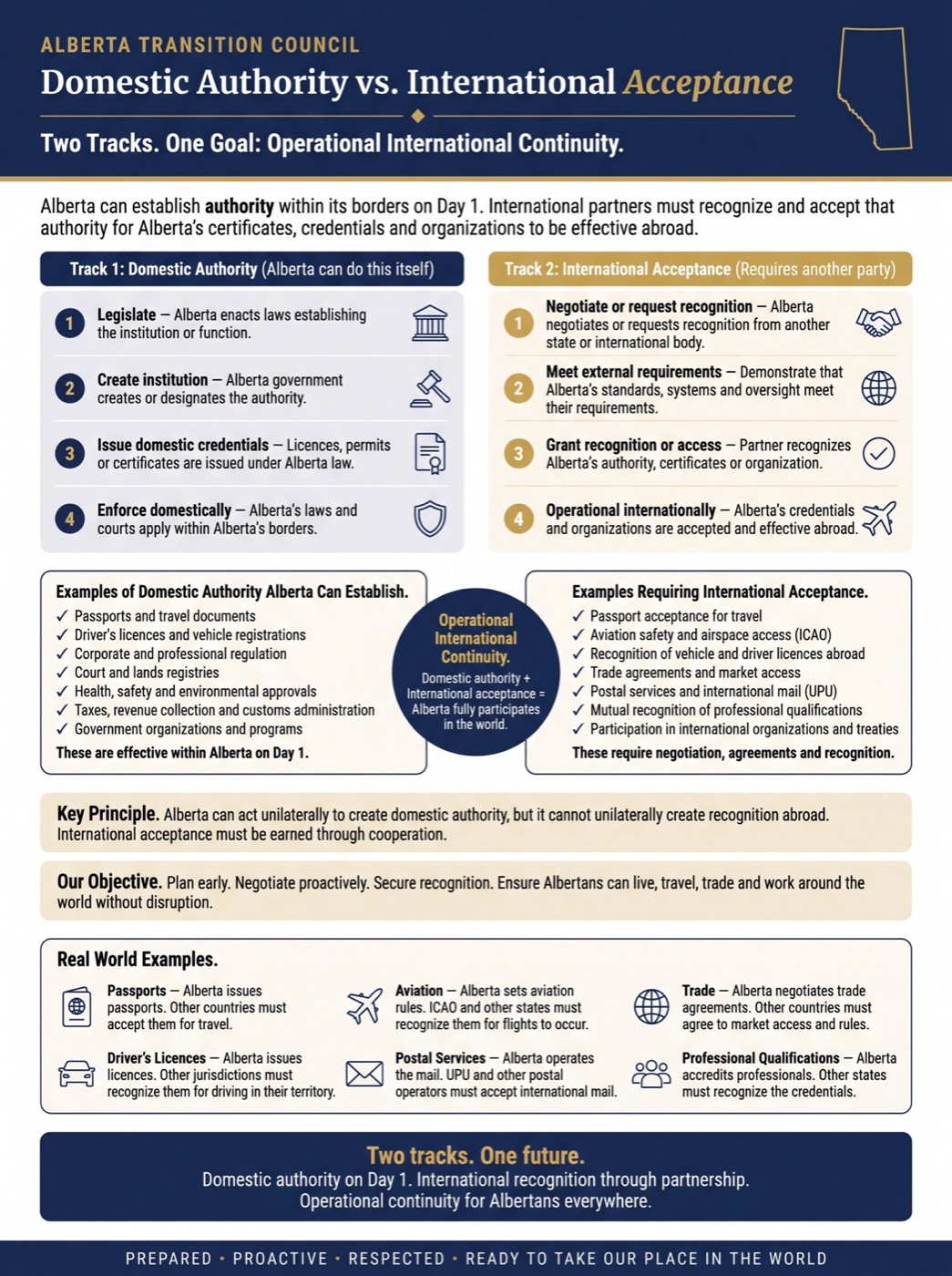
Selected references from white papers
- Canada-United States-Mexico Agreement (CUSMA).
- Canadian Free Trade Agreement (CFTA).
- World Trade Organization: Article XII accession procedures, GATT 1994, GATS, TRIPS and dispute-settlement framework.
- Government of Alberta: Trade and Investment: Alberta, 2024.