A Practical Plan for an Orderly Transition
This Alberta Transition Plan examines a practical question: if Albertans ultimately vote to become an independent country, what would have to be done to make the transition to independence orderly, lawful and workable?
The central conclusion of the research is straightforward. Alberta would not be starting from scratch.
Alberta already has a functioning government, Legislature, ministries, courts, municipalities, police services, health and education systems, resource regulators, tax administration, infrastructure, businesses and professional workforces. Most of the institutions and services Albertans rely upon every day already exist and operate in Alberta.
The principal transition challenge is therefore not to rebuild Alberta. It is to change the legal authority behind certain federal functions, transfer or bridge responsibilities now performed by the federal government, establish the sovereign functions Alberta does not presently have, and keep essential services operating throughout the process.
In many cases, what changes during a transition is not the service the public sees. What changes is the law, regulator, funding arrangement, government authority or international relationship behind it. Those changes can be planned, negotiated and implemented in stages; they do not all need to happen at once.
The same continuity principle applies to people. Thousands of federal employees live and work in Alberta, have built careers here and have families and communities here. Where the functions they perform will continue after independence, the practical objective should be to retain that experience wherever possible through negotiated transfers, recruitment, secondments or transitional service arrangements. For federal employees asking whether there can be a place for them doing the work they already know how to do after Day 1 of independence, the short answer is yes. Their knowledge and experience should be treated as an important part of Alberta’s existing institutional capacity, not as something that must be replaced.
To examine the transition requirements and prepare this plan, 45 Albertans with experience and expertise across a wide range of fields contributed to the preparation and review of 21 topic-specific White Papers. Their areas of knowledge and experience included banking and currency, law, international trade, First Nations, defence, and treaty matters, transportation, borders, policing and other major areas of government and the economy. The White Papers examined what would have to continue, what would have to change, what would require negotiation, and what new functions Alberta would need if it becomes an independent country.
This plan brings that work together in one document. It summarizes the principal research findings and recommendations in a form intended to help Albertans understand, at a practical level, how a transition from province to independent country could be organized if Albertans vote to proceed.
The plan is deliberately focused on transition, not on designing the future policies of an independent Alberta. It does not attempt to decide what Alberta’s long-term policies should be on matters such as taxation, policing, immigration, aviation or other areas of government. Those are democratic choices that would be made in the future by Albertans and the governments they elect. The purpose of this plan is narrower: to identify what must be in place so that government, services, rights, payments, businesses and critical systems continue to function through the transition.
This plan also does not contain the detailed costing of the transition or the broader financial assessment of independence. That work is being completed separately, and a companion report examining transition costs and related financial issues is expected to be released in the coming weeks. Together, these reports are intended to give Albertans more information about the practical and financial questions involved before the October 19 referendum.
The plan recommends that the transition be organized in three practical phases.
The Transition in Three Practical Phases
The transition from a successful October 19th vote, through the preparation period leading to the 2027 independence referendum, and full independence can be understood in three broad phases.
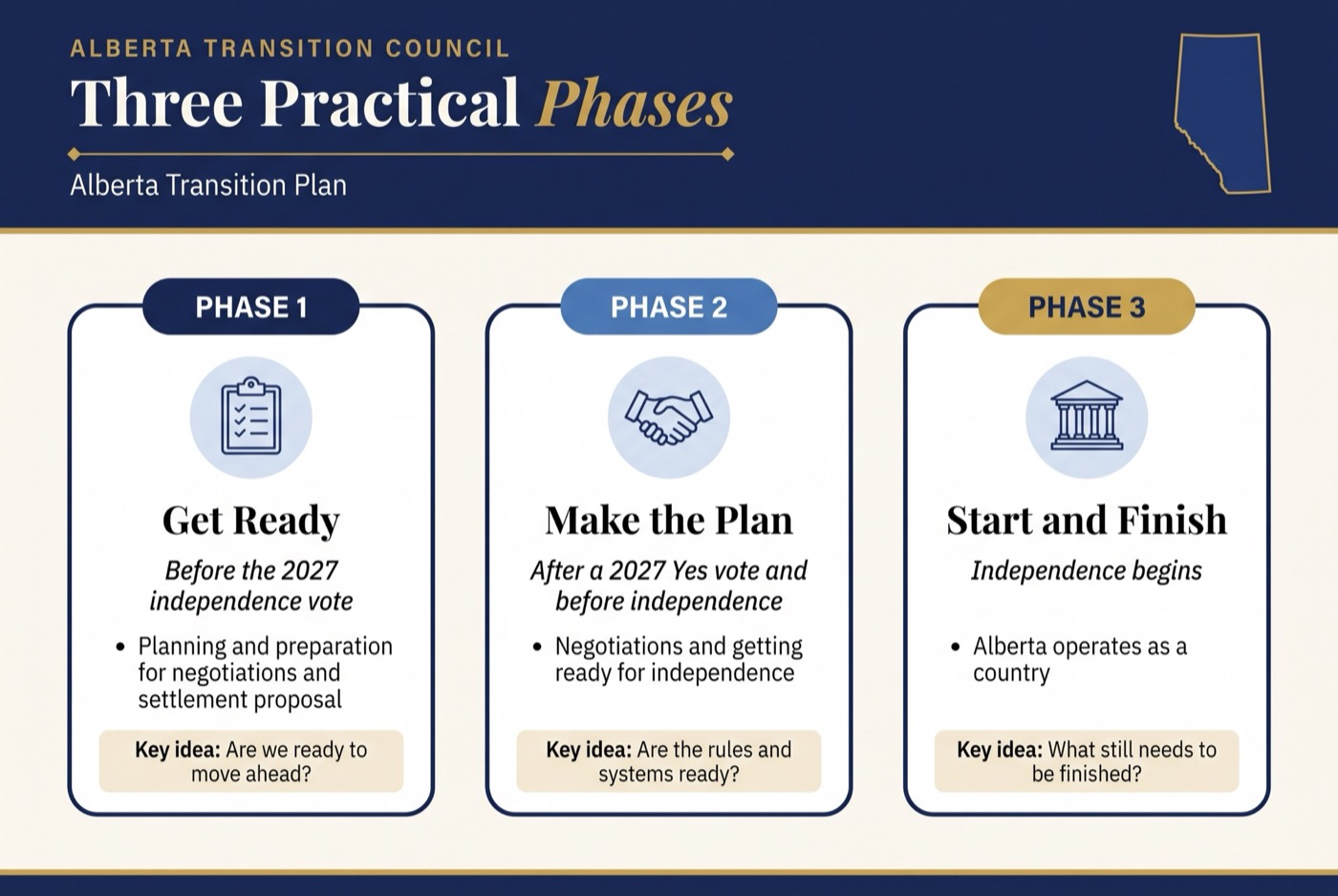
Three Practical Phases — Alberta Transition Plan public roadmap
Phase 1 — Prepare and Verify Transition Work
After October 19 and before a spring 2027 independence referendum
During this phase, Alberta remains a province of Canada.
If Albertans vote on October 19, 2026 to proceed to the next stage, the period before the proposed 2027 independence referendum provides an important opportunity to prepare. The Government of Alberta can establish a transition task force, verify the work already completed, refine cost estimates, identify federal functions that would have to be transferred or replaced, develop draft negotiating terms, inventory assets and records, engage First Nations and other affected parties, identify required legislation and agreements, and begin readiness and contingency work.
This 2026-2027 phase is about preparation, not independence. No practical changes occur merely because transition planning is taking place. The purpose is to ensure that, if Albertans later vote for independence in the spring of 2027, Alberta is ready to begin serious negotiations and implementation work without unnecessary delay or uncertainty.
Phase 2 — Negotiate and Get Ready for Independence
After a successful 2027 independence referendum and before Day 1 of independence
For planning purposes, this plan uses the spring of 2027 as the assumed date of the independence referendum. A successful referendum would provide the democratic mandate for Alberta to proceed with the legal process of independence. It would not itself make Alberta independent on that day.
Alberta would then move from preparation to formal negotiation and implementation. Consistent with the Reference re Secession of Quebec and the Clarity Act, a clear majority voting in favour of independence on a clear question would trigger a constitutional obligation to negotiate, although it would not itself effect secession. This phase would include good faith negotiations with Canada and the provinces, constitutional implementation; First Nations and treaty processes; settlement of debt, assets and liabilities; transfer or replacement of federal functions; arrangements for trade, borders, pensions, banking, transportation and other shared systems; workforce and records transfers; international preparations; and testing of critical Alberta systems.
The existing Government of Alberta would continue throughout this period. There would be no need to create a second or parallel transition government. This proposed timetable provides for an initial intensive negotiating period after the referendum and uses the currently scheduled October 2027 provincial election as an important democratic accountability point. Negotiations would not automatically stop because an election occurs or because a particular date is reached.
Most importantly, Day 1 of independence would not mean an overnight change or sudden disruption. It would be the agreed date on which Alberta formally becomes independent, following a planned and negotiated transition and once the necessary constitutional arrangements are in place and the critical systems and services Albertans rely on are ready to continue operating.
Phase 3 — Stabilize and Implement Independence
Day of independence and the period following
On Day 1 of independence, Alberta’s sovereign status changes and the Government of Alberta assumes the additional responsibilities of an independent country. For Albertans, however, the objective would be continuity and stability in daily life, with essential services, benefits, businesses and institutions continuing to operate. It is not the day on which every temporary arrangement, negotiation or administrative transfer must be finished; transitional arrangements can remain in place to ensure an orderly and practical transition.
After Day 1 of independence, Alberta would enter a stabilization and implementation period. Remaining transfers can be completed, temporary Canada–Alberta service arrangements can be replaced or extended where necessary, institutions can be refined, and systems can move from transitional to permanent arrangements.
This plan uses Day 1 plus 24 months as an outer planning horizon for temporary transition arrangements. It is not an automatic deadline requiring every temporary arrangement to end on that date. The objective of Phase 3 is to make the transition increasingly ordinary: fewer temporary arrangements, fewer unresolved transfers and progressively more functions operating under stable long-term arrangements.
The Constitutional Track for a New Alberta Constitution — A Separate Democratic Process
There is an important distinction between becoming an independent country and deciding the permanent constitutional design of that country. They are not the same process and they should not be placed on the same clock.
The independence transition is primarily about continuity and implementation: keeping government functioning, maintaining laws and courts, protecting rights, continuing public services and payments, establishing sovereign capabilities and completing the arrangements necessary for Day 1 of independence.
The permanent constitutional process asks a different question: what kind of constitutional system do Albertans want their new country to have? Questions about the permanent structure of government, the legislature, courts, rights protections, constitutional amendment procedures and other long-term institutions should not have to be finally decided before Albertans vote on independence.
The plan therefore places the development of Alberta’s permanent constitution on a separate Constitutional Track, allowing that process to proceed deliberately and with meaningful public participation without delaying the transition to independence.
| Independence Transition | Constitutional Track |
|---|---|
| Phase 1: Prepare and verify | Constitutional research and options can be developed. |
| Independence referendum | The referendum does not approve a permanent constitution. |
| Phase 2: Negotiate and prepare for Day 1 | Formal constitutional deliberations can begin once there is an independence mandate and sufficient clarity about the transition. |
| Day 1: Alberta becomes independent | Existing Alberta institutions continue under interim constitutional arrangements. |
| Phase 3: Stabilize and implement | Constitutional Conference develops the proposed permanent Constitution. |
| Transition arrangements are completed | Albertans vote on the proposed Constitution. |
| Transition End | Constitutional Commencement occurs when the ratified Constitution and permanent institutions are ready. |
There would therefore be no constitutional vacuum. The existing Legislative Assembly, Premier and Cabinet, ministries, public service and courts would continue through Day 1 of independence under lawful interim arrangements. Permanent constitutional choices would be made separately through the Constitutional Conference and voter-ratification process described in this plan.
This separation allows the independence transition to concentrate on continuity, stability and implementation without forcing Albertans to decide every permanent constitutional question at the same time.
What Does Day 1 of Independence Actually Mean?
For most Albertans, the practical test of a successful transition is to ensure ordinary life continues to work.
| Practical Question | Transition Objective |
|---|---|
| Who governs? | The same Government of Alberta continues. Day 1 expands its lawful responsibilities; it does not create an entirely new government. |
| Do the laws and courts still work? | Existing laws, rights, contracts, court proceedings, licences and government decisions continue through appropriate continuity arrangements. |
| Do people still get paid? | Government payroll, pensions and benefits continue through tested payment systems and appropriate transition arrangements. |
| Does banking still work? | Payments, deposits, mortgages, lending and financial services continue while the necessary sovereign regulatory and financial arrangements are put in place. |
| Can people and goods still cross borders? | Customs, immigration, transportation and trade systems are operational, with negotiated arrangements pursued wherever they are required. |
| Do businesses keep operating? | Existing businesses, facilities, contracts, professional workforces and licences continue wherever legally and practically possible. |
| Can Alberta trade with Canada and the world? | Trade systems, export certification, border processes and the necessary Canadian and international arrangements are operational. |
| Can Alberta act as a country? | Alberta has the necessary authority and capacity for borders, international relations, treaty management, national security and other sovereign functions. |
This is why the plan treats Day 1 of independence as a readiness decision. For each critical function, Alberta should be able to answer: Who is responsible? Is there legal authority? Are the people, funding, records and technology in place? Does the system connect to the outside organizations it depends upon? Has the first real transaction been tested?
Alberta Will Not Be Separating From Its Neighbours
Independence would change Alberta’s constitutional relationship with Canada. It would not change geography, family relationships, business networks, pipelines, railways, highways, banking relationships or the many other connections that exist between Albertans and Canadians.
For that reason, this plan assumes that a successful transition should seek a new cooperative relationship between Alberta and Canada, not the unnecessary disruption of existing relationships. Negotiations would therefore be expected to address such matters as trade, mobility, transportation, energy infrastructure, pensions, financial systems, public safety, legal cooperation, telecommunications, aviation, records and transitional public services.
Those arrangements are important negotiating objectives. They should not be treated as guaranteed outcomes before they are actually agreed. The same principle applies internationally. Alberta should prepare early for the recognition, agreements and technical relationships needed to operate as a country, while distinguishing between what Alberta can establish itself and what requires the agreement or recognition of Canada, another country or an international organization.
What Changes — and What Does Not
One of the most important findings of the transition research is that a change constitutional structure or regulatory authority over a service does not mean the service itself stops operating. In many cases, services can continue without interruption, while responsibility for their regulation, funding or oversight transitions from Canada to Alberta.
An airport does not cease operating because the national regulator changes. A bank branch does not disappear because the bank regulator changes. A hospital does not need to be rebuilt because a federal funding or regulatory relationship changes.
For every major service, the plan therefore asks five basic questions:
- 1. Who operates the service today?
- 2. Who employs the people?
- 3. What law or regulator gives it authority?
- 4. What records, payments, technology or networks does it depend upon?
- 5. What outside organization must continue to recognize or work with it?
Often, only one or two of those layers would need to change. The preferred transition method is therefore to continue what already works, transfer what can be transferred, negotiate temporary arrangements where cooperation is useful, and build new institutions only where Alberta genuinely requires a sovereign capability it does not presently have. Long-term policy redesign can then occur through ordinary democratic government after stability has been established.
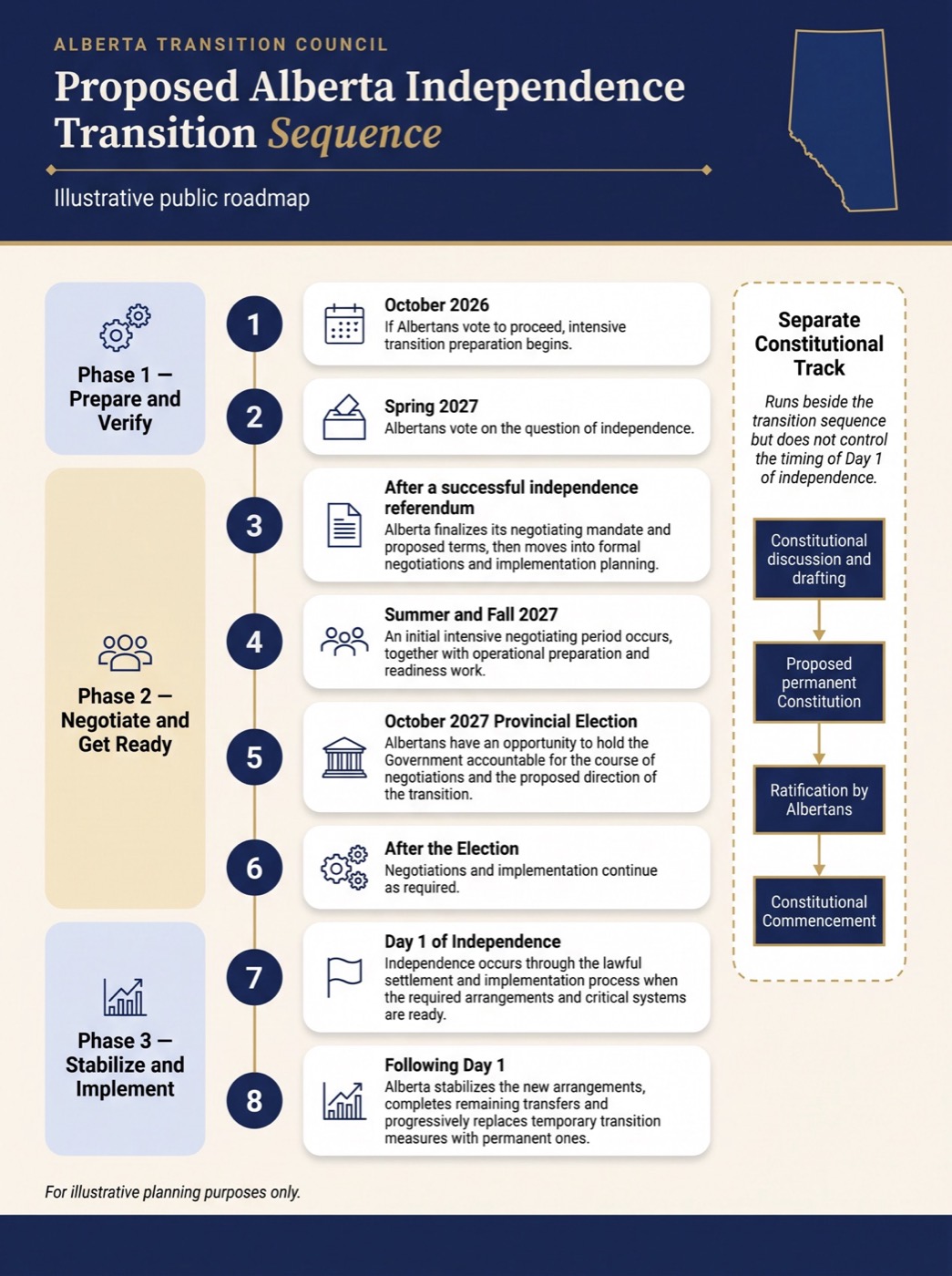
The Proposed Sequence
The detailed timeline is set out later in this plan. In broad terms, it contemplates:
October 2026: If Albertans vote to proceed, intensive transition preparation begins.
Spring 2027: Albertans vote on the question of independence.
Following a successful independence referendum: Alberta finalizes its negotiating mandate and proposed terms and moves into formal negotiations and implementation planning.
Summer and fall 2027: An initial intensive negotiating period occurs, together with operational preparation and readiness work.
October 2027 provincial election: Albertans have an opportunity to hold the Government accountable for the course of negotiations and the proposed direction of the transition.
After the election: Negotiations and implementation continue as required.
Day 1: Independence occurs through the lawful settlement and implementation process when the required arrangements and critical systems are ready.
Following Day 1: Alberta stabilizes the new arrangements, completes remaining transfers and progressively replaces temporary transition measures with permanent ones.
Running beside this sequence — but not controlling the timing of Day 1 of independence — is the separate Constitutional Track leading ultimately to a proposed permanent Constitution, ratification by Albertans and constitutional commencement.
The Purpose of This Report
This consolidated transition plan brings together research across the principal legal, financial, institutional and operational questions associated with a possible transition from province to independent country. It does not suggest that every negotiating outcome can be known in advance. Nor is that different from governing today: governments routinely make decisions in the face of changing national and international economic conditions, trade relationships, geopolitical events, financial markets and other circumstances beyond their control. The purpose of responsible planning is not to predict every future event, but to identify what can be anticipated, prepare for foreseeable risks and ensure Alberta has the capacity to respond as circumstances evolve.
Some decisions are within Alberta’s control. Some would require agreement with Canada and provinces. Some require direct engagement and arrangements with First Nations or Metis collectivities. Others depend upon foreign governments, international organizations or private networks. A credible transition plan must distinguish between those categories rather than treating uncertain outcomes as either guaranteed or impossible.
The purpose of this Report is therefore to identify:
- what already exists and can continue;
- what legal authority would have to change;
- which federal functions would need to be transferred, bridged, replaced or newly established;
- what agreements would need to be pursued; and
- what critical systems must work on Day 1.
The ultimate objective is straightforward: If Albertans decide to become independent, the transition should be lawful, prepared and orderly — and ordinary life should continue while the machinery of government changes behind the scenes.
That is the organizing principle of this Transition Plan.
Principal Findings and Conclusion
The overall finding of this plan is that a transition from province to independent country would be complex, but capable of being planned, organized and implemented in an orderly way. Alberta would not need to recreate the society, economy or public institutions that already exist. Most day-to-day services are already delivered by Alberta institutions, municipalities, First Nations and Metis governments and organizations, private businesses and professional workforces. The principal work would be to preserve what already functions, transfer or replace federal responsibilities where necessary, maintain connections with Canadian and international systems, and establish the limited number of sovereign functions Alberta does not presently require as a province.
The research does not suggest that every negotiating outcome can be known or guaranteed in advance. Some matters would require agreement with Canada, First Nations, other governments, international organizations or private networks. But the required functions and dependencies can be identified in advance, assigned to responsible institutions, negotiated or bridged where necessary, and tested before Day 1 of independence. The practical measure of a successful transition is therefore not how much changes, but how much continues to work: government continues, courts remain open, pensions and benefits are paid, banks operate, businesses continue, goods and people move, and essential services remain available while Alberta assumes full constitutional responsibility for its own governance, finances and laws.