Alberta in Perspective
The Executive Summary has set out the transition in three practical phases and has shown the permanent Constitutional Track separately. Before turning to the detailed chapters, it is useful to step back and consider the starting point for that roadmap: what is Alberta today, and what does that mean for the practical task of transition?
Alberta is not a small territory contemplating the creation of a modern society from scratch. It is a large, highly developed jurisdiction of more than five million people, with two major metropolitan centres, a sophisticated economy, modern public institutions, extensive transportation and energy infrastructure, an educated workforce, globally connected businesses and a mature system of government.
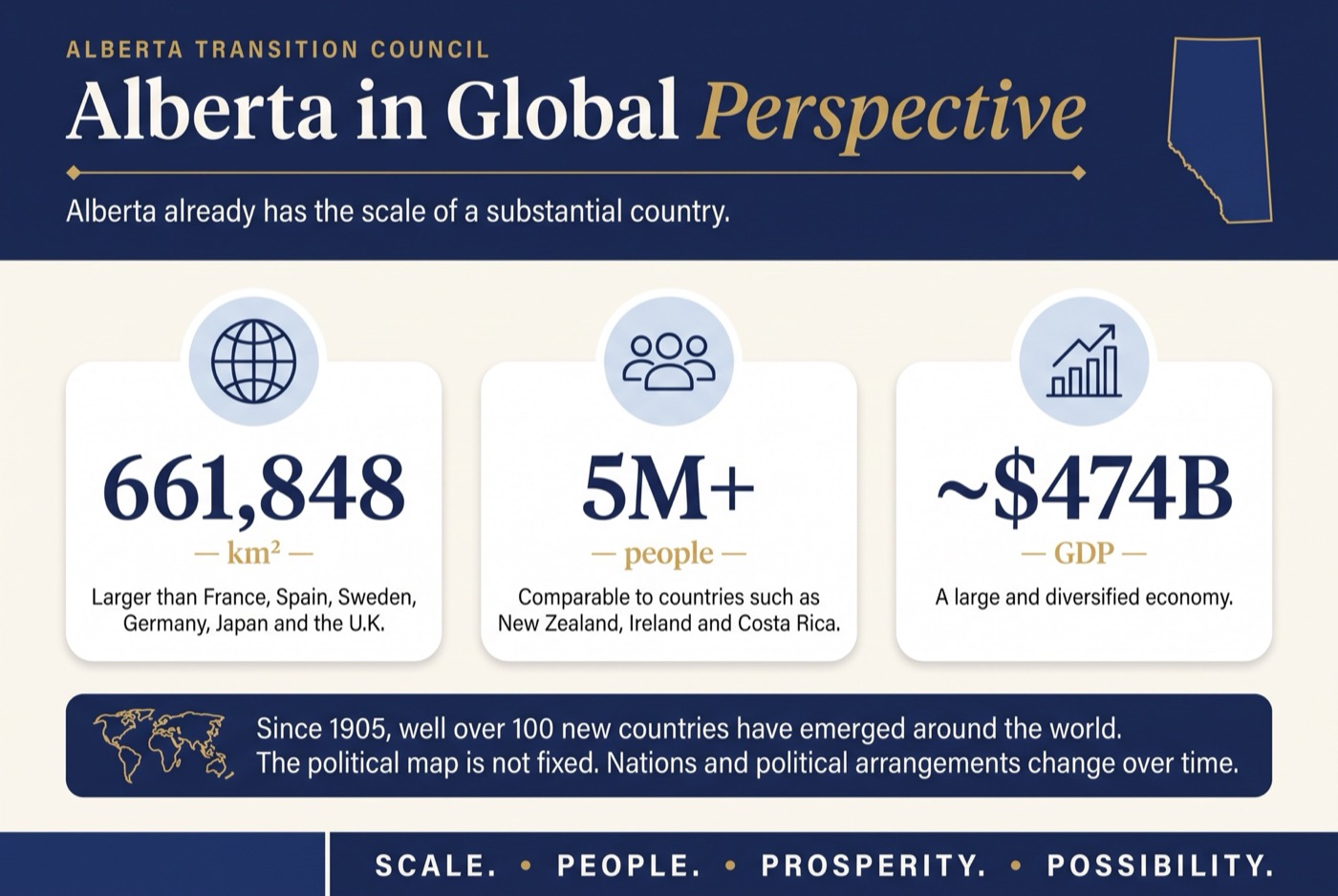
Geographically, Alberta is large by global standards, covering approximately 661,848 square kilometres. If Alberta were an independent country, it would rank at roughly 40th in the world by area—meaning it would be larger than about 80 percent of the world’s countries. Its land area is nearly three times that of the United Kingdom, almost twice that of Germany or Japan, and substantially larger than France or Spain. Put another way, among the nearly 200 independent countries in the world, only about 40 have more territory than Alberta. Alberta is therefore not merely a large Canadian province; geographically, it is comparable in scale to a major sovereign state.
An independent Alberta would not be a demographic outlier among countries. With a population of more than five million people, it would be a mid-sized country by the standards of the many nations that successfully govern populations of only a few million people.
Alberta's economy is substantial as well. Parliamentary research reports Alberta's 2024 gross domestic product at approximately C$473.9 billion. Expressed in U.S. dollars at typical recent exchange rates, that places the Alberta economy in the broad range occupied by established mid-sized national economies and approximately within the world's top 50 economies. Alberta also has the highest gross domestic product per person among Canada's provinces.
Since Alberta became a province in 1905, well over 100 new countries have emerged around the world. The political map is not fixed: the modern international system has repeatedly accommodated the emergence of new sovereign states through decolonization, negotiated separation, constitutional change and the dissolution or reorganization of existing states.
Those numbers matter because they put the transition question into perspective. Independence would not turn a small or undeveloped region into a country and then require its citizens to discover how to build an economy, construct cities, establish universities, organize hospitals, create courts or build roads. Those things already exist.
Alberta already has a legislature and executive government; courts and a legal profession; municipalities; police and emergency services; hospitals and health-care institutions; universities and colleges; schools; regulators; financial institutions; pension and investment organizations; utilities; telecommunications networks; airports; railways; highways; pipelines; power generation; sophisticated agricultural, food processing, and energy industries; manufacturing, construction and technology businesses; and a large professional public service.
The physical province would not move. Calgary would remain Calgary. Edmonton would remain Edmonton. The highways, farms, homes, hospitals, businesses, pipelines, airports, power plants and communities would remain where they are. Independence is fundamentally a change in constitutional and legal authority, not a physical separation of the land from its neighbours.
That distinction is the starting point for this transition plan.
A Resource-Rich, Modern and Internationally Connected Economy
Alberta's economic position is unusual for a jurisdiction of its population. It has a strong economic foundation that provides significant capacity to support a transition to independence.
It possesses one of the world's major energy resource bases. Alberta government data describe the province as holding the world's third-largest proven oil reserves, with approximately 99 percent of those reserves located in the oil sands. Alberta is also a major natural-gas producer, an important agricultural producer, a centre for petrochemicals and energy services, and home to growing manufacturing, technology, financial, professional and logistics sectors.
Energy is therefore an important part of Alberta's economic strength, but it is not the whole Alberta economy. Provincial economic data show major contributions from agriculture, real estate, construction, manufacturing and numerous service industries in addition to oil and gas.
Alberta also possesses the infrastructure of a modern trading economy. The province maintains approximately 64,000 lane-kilometres of provincial roads and more than 4,800 bridges and interchanges. Its highways connect east and west across Canada and south into the United States. Its railway systems connect producers and manufacturers to Canadian ports, United States (U.S.) markets and the wider continent. Its pipelines connect Alberta energy to British Columbia, Ontario, the American Midwest, the U.S. Gulf Coast—including the major refining and petrochemical hub around Houston—and the U.S. West Coast, while also providing access to overseas markets.
Of particular importance is Alberta's economic orientation toward the U.S.. The U.S, is by far Alberta's largest international trading partner; Alberta exported approximately C$151.5 billion of goods to the U.S. in 2025. Alberta's north-south highway corridors were deliberately developed to connect the province efficiently with that market.
Alberta would remain immediately beside the U.S., one of the world's largest markets. Existing rail lines, highways, pipelines, commercial relationships and supply chains would not vanish because the constitutional status of Alberta changed. What would change is the legal framework governing their use: customs, trade agreements, licences, carrier recognition, immigration rules and international regulatory arrangements would have to be preserved, replaced or negotiated.
That is a recurring theme throughout this plan. The physical and commercial system generally already exists. Before the referendum, the focus is therefore on identifying and verifying the legal, governmental and external arrangements surrounding those systems (Phase 1). Following a successful referendum, the focus shifts to negotiating, transferring, building and testing what must change before Day 1 of independence (Phase 2). After independence, the focus is on maintaining stability and continuity while completing any remaining implementation work (Phase 3).
Canada Already Has a Constitutional Framework for Secession
There is another unusual feature of the Alberta question that distinguishes it from many independence movements elsewhere in the world.
Canada's own Supreme Court has already addressed how a province can lawfully become an independent nation.
In the 1998 Reference re Secession of Quebec, the Supreme Court of Canada held that a clear majority on a clear question in favour of secession would give democratic legitimacy to the initiative and create a reciprocal constitutional obligation on the federal and provincial governments to negotiate. The Court emphasized that these are binding obligations under the Constitution of Canada. It also stated that determining what constitutes a “clear majority on a clear question” would be for the “political actors” to determine in the circumstances of a particular referendum.
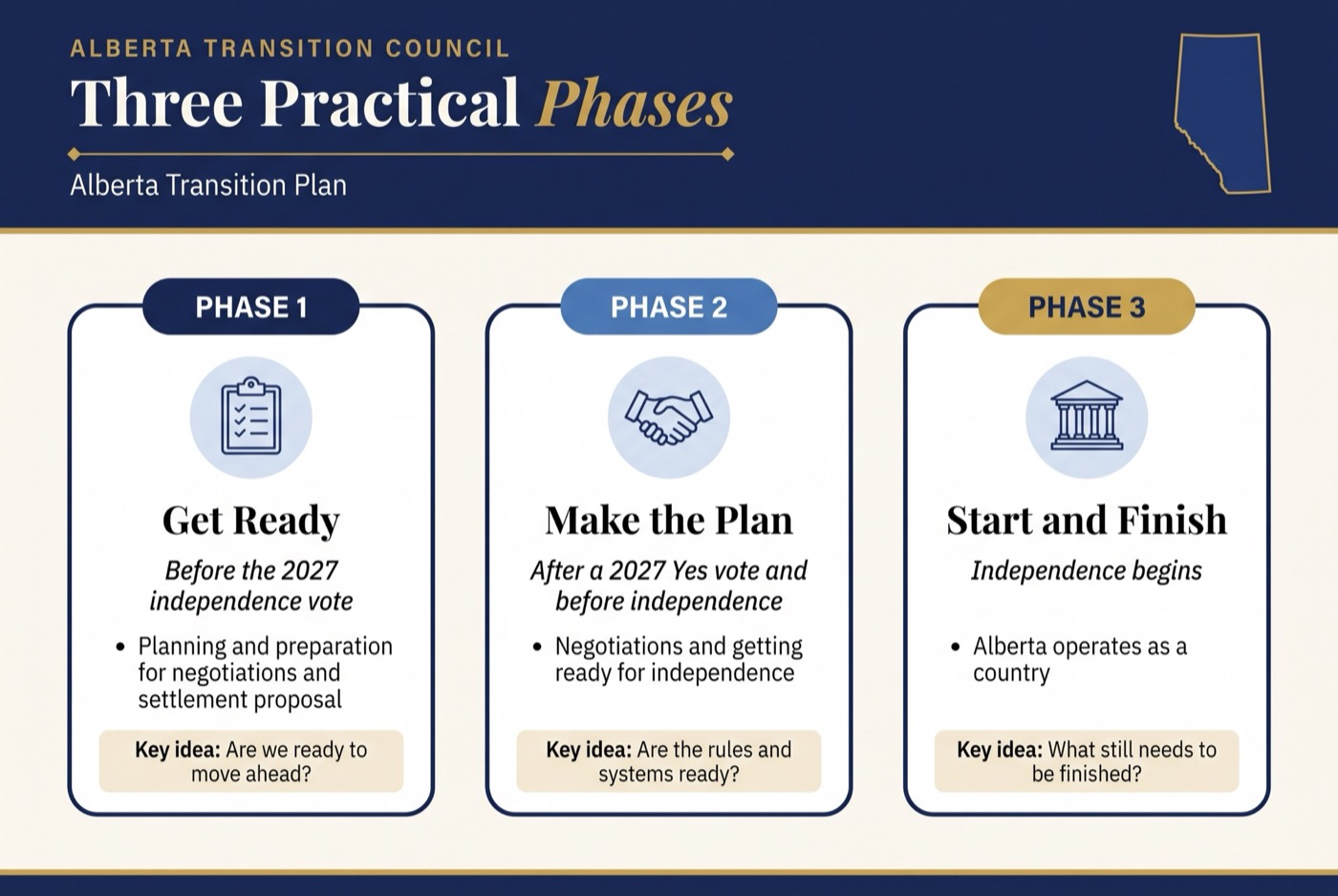
The referendum itself would not make Alberta independent. That distinction is central to the three-phase roadmap in the Executive Summary: Phase 1 is preparation before the 2027 independence referendum; Phase 2 begins only if a successful referendum supplies the democratic mandate for negotiations and implementation; and Phase 3 begins on Day 1 of independence, once the lawful arrangements required to make independence effective are in place..
The Clarity Act and an Important Constitutional Disagreement
Following the Reference re Secession of Quebec case, Parliament enacted the federal Clarity Act in 2000. The Clarity Act claims to give the House of Commons an expanded role in a provincial secession referendum including assessing whether the question is clear and then later whether the vote results were of a clear majority. The Clarity Act further provides that the Government of Canada must not enter secession negotiations if the House of Commons concludes either that the question was not clear or that a sufficiently clear majority was not achieved.
There is, however, an important constitutional problem with the validity of these expanded federal roles. The Supreme Court did not say that the House of Commons gets to review and approve the wording a province chose to use in an independence referendum or whether the majority vote is clear. The Court made clear that the constitutional obligations identified in the Secession Reference are binding.
That distinction matters. Parliament cannot use an ordinary federal law like the Clarity Act to give the House of Commons the power to cancel a constitutional duty to negotiate that has otherwise arisen under the Constitution.
Quebec has expressly rejected Ottawa’s broader interpretation. In response to the Clarity Act, the Quebec National Assembly enacted Bill 99, the Act respecting the exercise of the fundamental rights and prerogatives of the Québec people and the Québec State. Among other things, that law provides that 50 per cent plus one of the valid votes cast is a majority in a Quebec referendum and declares that no other parliament or government may impose limits on the democratic will of Quebecers to determine their political future.
The existence of this disagreement does not prevent practical transition planning. Nor does this plan need to resolve every potential constitutional dispute surrounding the Clarity Act in advance. For planning purposes, the appropriate foundation remains the constitutional framework established by the Supreme Court: a clear democratic mandate on a clear question creates constitutional consequences and a reciprocal obligation to negotiate in good faith in accordance with the principles of federalism, democracy, constitutionalism and the rule of law, and the protection of minorities.
The legal sequence contemplated by Canadian constitutional law can therefore be described in relatively simple terms:
- 1. Alberta asks its population a clear question about whether Alberta should cease to be part of Canada and become an independent country.
- 2. If the result demonstrates a clear majority in favour of secession, the constitutional duty to negotiate arises.
- 3. Alberta, Canada and the other constitutional participants negotiate the terms on which separation could occur.
- 4. Those negotiations address matters such as assets and liabilities, borders, Indigenous rights and interests, minority rights, institutional arrangements and the many practical transition issues identified in this plan.
- 5. The settlement is implemented through the constitutional amendments, legislation, agreements and operational measures required to make lawful secession effective. The Alberta Legislature, Premier and Cabinet, ministries, agencies, public service and administrative machinery continues to govern throughout the transition, through an election.
The purpose of the plan is not to make the political case for or against independence, but to identify, organize and explain the legal, institutional, financial and operational work that would be required if Albertans decide to proceed.
The Central Insight of This Transition Plan: We Already Know the Federal Functions
For many people, independence can understandably sound intimidating. The word itself can create the impression that Alberta would suddenly have to invent hundreds of unfamiliar institutions and build an entirely new country from scratch. That is not the practical problem Alberta would face.
Every function discussed in this transition plan is already being performed today either by the Alberta government or by the Federal government.
Someone already collects the federal income tax paid by an Alberta resident. Someone already regulates a federally chartered bank. Someone already issues passports. Someone already screens passengers at an airport. Someone already administers a federal pension payment. Someone already inspects railways. Someone already processes goods at the Canada-U.S. border.
This is enormously important from a planning and budgeting perspective. Independence does not create these functions; it changes who is responsible for delivering, regulating or overseeing some of them. In the case of federal oversight, that responsibility would move closer to the people, businesses and industries affected by those decisions.
The functions the Government of Canada provides for Albertans are known with a high degree of precision.
The transition question is not, 'What does a country need?' in the abstract. The practical question is, 'Who performs this function for Albertans today, how does it work, and what has to change so that it continues to work through without interruption as constitutional authority changes?'
In many cases, surprisingly little changes.
An Alberta hospital does not have to become a new hospital. A municipal fire department does not have to become a new fire department. An Alberta school does not have to become a new school. A privately owned telecommunications network does not have to be rebuilt. A bank does not need to close its Alberta branches and reopen them under a different name. Calgary International Airport does not need to be reconstructed. A railway company does not need to replace its locomotives. A homeowner does not need to replace a house or mortgage simply because the constitutional jurisdiction surrounding the contract changes.
Those systems already operate. The objective of transition planning is to keep them operating.
Other functions require a transfer of legal authority. Some require access to federal records or the recruitment or transfer of experienced personnel. Others may require Canada to continue providing a service temporarily while Alberta establishes a replacement. Networked functions—bank payments, rail transportation, aviation, pipelines and telecommunications, for example—require agreements so that systems on both sides of the new boundary continue to recognize and communicate with one another.
A smaller category of services would have to be built because Alberta does not presently require them: a sovereign foreign ministry, a national customs authority, independent treaty-making capacity and national defence command are obvious examples. Even in these areas, however, Alberta would not be starting without existing people, infrastructure, expertise or institutions on which to build.
The purpose of the Transition plan is to identify those differences rather than treating every federal function as though it must be recreated from zero. Across the three phases, the Report therefore uses a simple four-part operating test:
continue what already works;
transfer what must change hands;
negotiate continued interfaces where systems cross borders; and
build only the genuinely sovereign functions Alberta does not possess today.
A Simple Transition Test
Keep existing Alberta/local/private operations running.
Move legal authority, staff, records, funding or assets where necessary.
Secure continued recognition, access or interoperability across borders and networks.
Create only the sovereign capabilities Alberta does not possess today.
Transition as an Integration Project
There is a useful analogy in the commercial world.
When one large company acquires another, the purchaser does not normally demolish the acquired company and rebuild every function from scratch. It identifies what already works, determines which employees and systems need to continue, maps contracts and liabilities, transfers legal authority, integrates information systems, establishes new reporting relationships, negotiates arrangements with outside parties and carefully plans the date on which responsibility changes.
A sovereign transition is obviously more consequential than a corporate acquisition because it involves constitutional rights, Indigenous and treaty relationships, democratic legitimacy, international recognition and public law considerations that do not arise in an ordinary business transaction. But the operational comparison is useful.
Complexity does not mean uncertainty about everything, nor does it make responsible planning impossible.
The more thoroughly a transition is broken into individual functions, the less mysterious it becomes. Tax and pension administration, banking regulation, aviation safety and border administration are all established functions with identifiable processes and requirements, each of which was itself created, developed and implemented through deliberate preparation and institutional design, similarly to the approach in this plan.
Each has people, laws, records, facilities, technology, funding and external relationships that can be inventoried before Alberta transitions from a province to a sovereign country.
That is why the central objective of this plan is not dramatic institutional change on Day 1 of independence. It is the opposite: deliberate normality.
The measure of success would be that ordinary life continues while constitutional authority changes behind it.
Independence Would Reset a Relationship, Not End One
Alberta independence would not eliminate Alberta's relationship with the rest of Canada. It would change the legal and governmental framework within which that relationship operates.
Geography makes and ongoing relationship both inevitable and important, and there would be significant benefits to both Alberta and Canada in maintaining strong economic, social and practical ties.
Families cross provincial boundaries. Companies operate in multiple provinces. Railways and highways cross provincial lines. Electricity, telecommunications and financial systems are interconnected. Alberta products travel through British Columbia to Pacific markets and across Saskatchewan and Manitoba toward central Canada. Canadian goods travel through Alberta. Pension, professional, educational and personal relationships extend across the country.
Independence would therefore change the terms of Alberta’s relationship with Canada, not bring that relationship to an end. Indeed, a negotiated relationship between two neighboring countries could preserve existing areas of cooperation while creating opportunities for new arrangements that better reflect their respective interests.
The important difference is where government authority and democracy accountably ultimately reside. In other words, it changes how government programs and services are administered, not how government programs and services are received.
Today, decisions within federal jurisdiction are made by Ottawa-based Canadian institutions accountable to voters across the entire country. Alberta participates in those institutions but cannot by itself determine their policy. Supporters of independence argue that this structure can leave Albertans unable to change national policies concerning matters such as taxation, criminal law, immigration, national environmental regulation or international trade even where a majority of Alberta voters strongly prefers a different approach.
Independence would change the location of final democratic accountability for those sovereign powers. Decisions assigned to an independent Alberta would ultimately be made by governments elected by Alberta voters, who could in turn remove those governments through Alberta elections.
That is the core democratic proposition behind independence. It does not require hostility toward Canadians elsewhere or an end to the close relationships that already exist. It asks a different question: which electorate should have the final authority to choose the government making decisions for Alberta in fields that are presently federal?
If independence occurred, Alberta and Canada could then negotiate how their existing relationship should operate under the new legal framework, including trade, movement of people, transportation corridors, pensions, policing cooperation, energy, financial systems, aviation, telecommunications and other matters of mutual interest. The objective would not be separation for its own sake, but a different political relationship that allows each country greater control over its own affairs while preserving cooperation where cooperation benefits both.
Negotiation Would Occur in a Setting of Mutual Dependence
Those negotiations would not take place between one side possessing all the leverage and another possessing none.
Alberta would bring significant economic assets to the table: energy production, continental pipelines, major highways and rail corridors, agricultural production, a large export economy and extensive commercial relationships with the United States.
The rest of Canada would bring equally important assets: a large neighbouring market, access to ports and transportation corridors, existing national and international agreements, established financial and administrative systems and longstanding commercial relationships.
British Columbia illustrates the depth of that interdependence particularly well. Although British Columbia has direct access to the Pacific, it is effectively continentally landlocked by the Rocky Mountains when moving goods eastward to the rest of Canada and inland North American markets. More than $55 billion in British Columbia goods and products move east through Alberta’s highways and rail corridors each year, along with more than 900,000 containers of consumer and industrial goods produced in Asia, landed at the ports of Vancouver and Prince Rupert, and then transported inland through Alberta. Alberta is therefore not simply another market for British Columbia; it is a critical part of British Columbia’s land connection to the continent.
British Columbia is also heavily dependent on Alberta for critical energy supplies. The Trans Mountain pipeline originates near Edmonton and carries Alberta crude oil and refined petroleum products across British Columbia to Kamloops, Burnaby, Washington State and Pacific export facilities. The expanded system has approximately 890,000 barrels per day of capacity. British Columbia’s largest refinery, the Parkland refinery in Burnaby, relies primarily on light crude delivered through Trans Mountain, while the pipeline also supplies refined petroleum products directly into the British Columbia market.
That dependence cannot realistically be replaced quickly. Alberta is deeply integrated into British Columbia’s day-to-day energy supply, and developing substitute sources, infrastructure and transportation capacity would take substantial time and investment. Likewise, British Columbia has a strong interest in preserving reliable access to Alberta energy because there is no readily available near-term replacement for that supply.
Ontario and Quebec are similarly integrated with Alberta and western Canadian energy supplies. The Enbridge Mainline originates at Edmonton and carries western Canadian crude oil, refined petroleum products and natural-gas liquids east through the continental pipeline network to Sarnia, Ontario, the centre of one of Canada’s largest refining and petrochemical complexes. From Sarnia, connected pipelines supply refineries elsewhere in Ontario and carry crude east through Line 9 to Montreal. The resulting refineries produce the fuels on which the central Canadian economy depends—including gasoline for motorists, diesel for trucking, construction, mining and industrial equipment, and jet fuel for major airports. Federal authorities have described Line 5 alone as supplying roughly half of the feedstock used by Ontario refineries and about two-thirds of Quebec’s crude-oil requirements, while Toronto Pearson is heavily reliant on fuels produced from this supply system.
This dependence extends beyond crude oil itself. Refineries supplied through the western Canadian pipeline system convert that feedstock into gasoline, diesel, aviation fuel, petrochemical products and other refined products that move throughout Ontario and Quebec. Line 9 supplies Ontario and Quebec refineries, while the Trans-Northern system distributes refined products to markets including Toronto, Ottawa, Kingston and Montréal. These are large, integrated systems built over decades; replacing western Canadian supply quickly would require alternative crude sources, transportation capacity and significant infrastructure changes. The Canada Energy Regulator has specifically concluded that an extended disruption to the Mainline—the principal connection between western Canadian production and central Canada—could create a significant challenge in meeting the region’s refined-product demand.
The economic interdependence also runs westward. Ontario manufacturers and wholesalers sell billions of dollars of goods annually into Alberta and British Columbia, much of which moves across the western Canadian highway and rail network. Ontario manufacturers alone sold approximately $11 billion of goods directly to British Columbia in 2022, before accounting for wholesale trade or Ontario goods destined for Alberta and other western markets. For goods continuing to British Columbia and Pacific export gateways by land, Alberta forms part of the principal continental rail and highway corridor. Ontario therefore has its own strong economic interest in preserving reliable east-west transportation access through an independent Alberta, just as Alberta would have an interest in preserving access to Ontario and Quebec markets.
Alberta’s economic interdependence with the rest of Canada extends well beyond transportation and energy. Alberta businesses and consumers purchase substantial amounts of goods and services from other provinces, and Ontario–Alberta wholesale trade alone exceeded $124 billion last year. Alberta is also an important part of Canada’s financial system. Although the major banks do not publicly report provincial revenue figures, Bank of Canada data show approximately $253 billion in personal and business deposits booked in Alberta by chartered banks. These relationships run in both directions. Alberta benefits from continued access to Canadian goods, services, financial institutions and transportation networks, while businesses and institutions elsewhere in Canada have a substantial commercial interest in continued access to Alberta’s consumers, deposits, resources and export economy. This mutual dependence does not predetermine the terms of any future negotiations, but it provides strong practical incentives on all sides to preserve stable economic relationships and negotiate workable arrangements.
This innate interdependence is significant for transition negotiations. Neither side has an economic interest in interrupting these corridors and trade relationships. It creates a powerful practical incentive for Alberta and Canada—and particularly Alberta and British Columbia—to negotiate durable arrangements preserving rail and highway transit, pipeline operations, port access, energy flows and the efficient movement of goods in both directions.
The same is true elsewhere. Alberta's crude-oil pipeline systems connect Edmonton and Hardisty with Saskatchewan, Manitoba, Ontario and U.S. refining markets. Those consuming markets value reliable Alberta supply; Alberta producers value reliable access to those markets.
The practical implication is not that either side should threaten the other. It is that there are powerful economic reasons for both sides to negotiate stable arrangements.
Canadian history provides a useful reminder. During the federal-provincial energy conflicts of the 1970s and early 1980s, Alberta under Premier Peter Lougheed used the province's ownership of and policy authority over natural resources as part of a much broader political and constitutional negotiation with Ottawa. The period ultimately produced negotiated energy arrangements and coincided with the entrenchment of provincial natural-resource authority in section 92A of the Constitution Act, 1867.
The lesson is not that the circumstances of the 1980s can simply be repeated. It is that economic interdependence creates reasons to negotiate—and that difficult Canada-Alberta disputes have historically been resolved in negotiated arrangements.
The Question This Plan Addresses
The detailed transition analysis that follows shows how the transition can occur if Albertans vote to proceed with independence.
How will laws continue? How will courts operate? How will salaries and pensions continue to be paid? How will money continue to move through banks? How will airplanes continue to fly? How will trucks and trains cross borders? How will homeowners keep their mortgages? How will businesses continue their contracts? How will First Nations rights and services continue while Nation-specific relationships are negotiated? How will hospitals obtain medicines? How will energy continue to reach markets? How will Alberta collect revenue? How will citizens continue to travel?
Once those questions are examined function by function, the transition becomes much less abstract.
Most of the people are already here.
Most of the physical assets are already here.
Most of the institutions are already here.
Most of the commercial relationships are already here.
Most of the trades and professional expertise are already here.
And every federal function that affects Alberta today is, by definition, already being performed somewhere by identifiable people under identifiable laws using identifiable systems.
That does not make independence automatic, inexpensive or risk-free. Negotiations could be difficult. External recognition matters. Some agreements would be indispensable. Indigenous and treaty issues require direct and careful treatment. Currency, debt, trade and investment outcomes matter enormously.
But those are reasons for disciplined planning, not reasons to treat the transition as unknowable.
With the three-phase roadmap and separate Constitutional Track as the organizing framework, that is the perspective from which the chapters that follow should be read.
Selected references from white papers
- Supreme Court of Canada: Reference re Secession of Quebec, [1998] 2 S.C.R. 217.
- Government of Canada: Clarity Act, S.C. 2000, c. 26.
- Statistics Canada / Government of Alberta: Alberta population and land-area statistics.
- Library of Parliament: Alberta economic and gross domestic product profile.
- Government of Alberta: Energy and minerals; provincial economic dashboard; transportation infrastructure; Alberta–United States trade profile.
- Canada Energy Regulator: Alberta and British Columbia energy profiles; Trans Mountain and refinery-market context.
- Alberta historical resources: Federal–provincial energy disputes during the Lougheed era and the development of section 92A.