Current and Proposed Court Structure
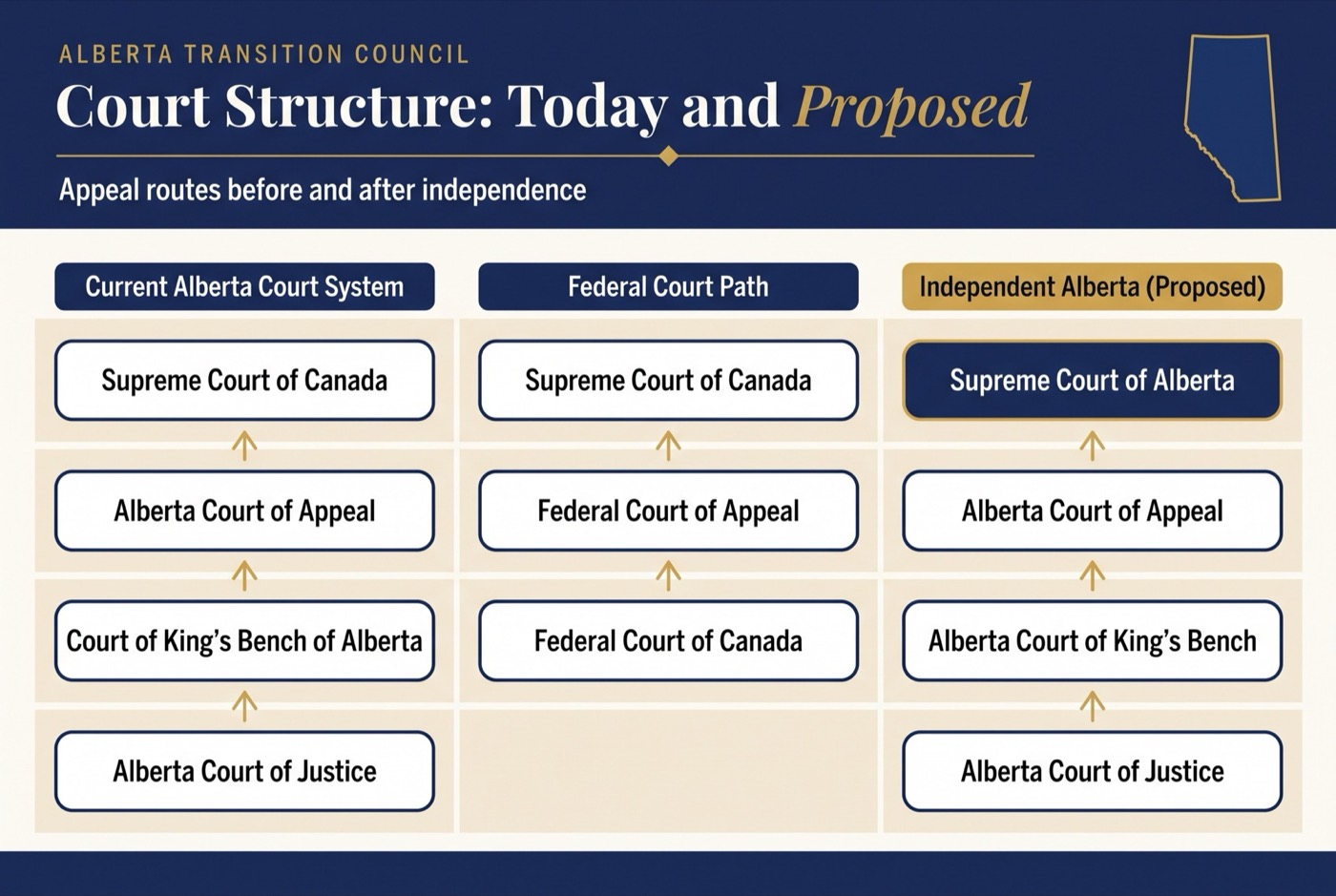
Today, there are three levels of Alberta courts: Alberta Court of Justice, Alberta Court of King’s Bench and the Alberta Court of Appeal. There are also three levels of federal courts: the Federal Court, the Federal Court of Appeal and the Supreme Court of Canada. Upon independence, A sovereign Alberta could transfer the authority currently exercised by these federal courts to its existing superior and appellate courts.
Alberta’s Court of King’s Bench could assume responsibility for federal matters that would fall within Alberta’s jurisdiction, while the Alberta Court of Appeal could assume the appellate and final-review functions currently performed by the Federal Court of Appeal and the Supreme Court of Canada. This would allow Alberta to preserve its existing courts while expanding their legal authority, rather than creating an entirely new court system on Day 1 of independence.
Alberta already has the physical infrastructure, personnel and institutions needed to operate a court system, including court buildings, registries, clerks, prosecutors, legal aid infrastructure, provincial judges and a large practicing bar. Criminal, civil, family and administrative matters are already heard every day in Alberta. The federal connection is not that cases are routinely tried or managed by the federal government. Rather, parts of Alberta’s court hierarchy, judicial appointment system, criminal law and final appellate processes currently derive their authority from the Canadian constitutional order and legal system. Some court records and pending appeals may be held by, or depend on, Canadian institutions during the transition process.
A further distinction is useful: the court, the law and the justice system are not the same thing. A courthouse is a facility; a judge is an independent office-holder; a prosecutor represents the public in a criminal case; police investigate and execute warrants; corrections holds or supervises offenders; and a legislature writes much of the law. A transition can leave the same building and many of the same professionals in place while changing the legal source of their jurisdiction.
The primary risk on Day 1 of independence is therefore not a lack of courthouses, staff or legal professionals. It is ensuring that Alberta’s courts and justice system have clear legal authority to continue operating without interruption. For a court system to function, all of its institutional, legal and operational parts must work together. These include the physical court and registry; the judge and staff; the law that gives the court jurisdiction; the rules of procedure; the police, prosecutors, lawyers and corrections system that carry out orders; and the appeal route above the court. Most of the physical and professional infrastructure already operates in Alberta. The transition task is therefore to ensure that the legal authority and appeal functions currently administered by the federal system continue without interruption.
A pending lawsuit or criminal prosecution should not have to start over because sovereignty changes. Continuity legislation can preserve the case, the evidence already filed, existing orders and limitation periods, while new Alberta law identifies which court hears the next step and where the final appeal goes. The genuinely external issues are narrower: extradition, recognition of Alberta judgments outside Alberta, access to Canadian records and formal government-to-government assistance in criminal investigations. Those matters require agreements, but they do not require rebuilding any courthouse or legal office.
The white paper recommends the plan preserve existing laws, rights, contracts, licences, proceedings and orders; deems judges and court officers to continue where legally supportable; maintains prosecution, corrections and civil enforcement; and establishes a clear appellate endpoint. Longer-term court redesign can follow. The hardest external questions are ongoing appeals, access to records, extradition, formal government-to-government legal assistance and recognition of Alberta judgments outside Alberta. Those are legal-cooperation questions, not reasons to rebuild the trial-court system from zero.
3.1 Continuity of the Courts
Existing court facilities, registries, staff, procedures and active cases should continue wherever possible. A new Continuity of Laws Act and Courts Act enacted by the Alberta Government would vest jurisdiction, carry forward proceedings and preserve the legal effect of prior orders and judgments.
3.2 Superior and Appellate Court Arrangements
The authority of each court must be clear from Day 1 of independence. The Government of Alberta currently appoints judges to the Alberta Court of Justice, while the Government of Canada appoints judges to the Alberta Court of King’s Bench and the Alberta Court of Appeal.
To avoid any interruption, transitional legislation could provide that all existing federally appointed judges serving on Alberta courts continue in office, with their tenure and remuneration protected. The same legislation would confirm each court’s jurisdiction and establish the applicable appeal routes.
3.3 Establishment of Final Appellate Jurisdiction
A sovereign Alberta would ultimately require its own final appellate authority similar to the role currently provided by the Supreme Court of Canada. The supporting transitional analysis leaves an important sequencing choice. Alberta could establish an interim final court of appeal for Day 1 of independence, using a temporary structure until the permanent Constitution determines the long-term court system. Alternatively, Alberta and Canada could negotiate arrangements allowing appeals that were already underway before Day 1—such as cases already before the Supreme Court of Canada or for which leave to appeal had already been sought or granted—to continue to completion under the existing Canadian process, while new Alberta cases would follow the transitional Alberta appeal structure to the new Supreme Court of Alberta. The objective in either case is to avoid interrupting pending litigation while ensuring that Alberta has a clear and lawful final appellate authority from the beginning of independence.
3.4 Prosecution Services
Most criminal prosecutions in Alberta are already conducted by the Alberta Crown Prosecution Service. Alberta Crown prosecutors presently prosecute the ordinary Criminal Code caseload, youth prosecutions and provincial offences throughout the province. Federal prosecutors perform a more limited but important role, concentrated particularly in drug prosecutions and offences under federal regulatory statutes. The transition task is therefore not to create a prosecution service from scratch. Alberta already has the prosecutors, Crown offices, management structure, disclosure systems and courtroom experience required for the bulk of criminal prosecutions. The principal Day 1 independence change would be to expand Alberta's existing prosecution mandate to include the federal offences and prosecution responsibilities that would no longer be exercised by the Public Prosecution Service of Canada in Alberta.
3.5 Pending Litigation and Proceedings
Proceedings should carry forward in the same procedural posture, preserving limitation periods, interlocutory orders and appeal rights. Cases already in federal courts or the Supreme Court of Canada would require a negotiated transfer, completion or transitional appellate rule.
3.6 Recognition and Enforcement of Judgments
Alberta would not be starting from zero in this area. Canadian provinces already have established rules for recognizing and enforcing judgments from other provinces, and Canadian courts also recognize qualifying foreign judgments subject to safeguards such as proper jurisdiction, procedural fairness and public policy.
On Day 1 of independence, Alberta could continue these existing principles through continuity legislation while negotiating a reciprocal recognition agreement with Canada. The practical objective is simple: a valid Alberta judgment should remain enforceable against a person or assets in Canada, and a valid Canadian judgment should remain enforceable in Alberta.
3.7 Litigation and Proceeding Transition Schedule
A change in Alberta's constitutional status should not cause existing lawsuits, prosecutions, appeals, tax disputes, regulatory proceedings or arbitrations to start again.
No civil, criminal, regulatory or administrative proceeding should be required to restart solely because Alberta's constitutional status changes.
The practical objective is to preserve the position of every proceeding immediately before Day 1. Pleadings already filed remain filed. Evidence already admitted remains part of the record. Orders and judgments remain effective. Limitation periods, hearing dates and appeal rights are preserved. Where the same Alberta court can continue hearing the matter, the file should simply remain there. Where a proceeding is before a Canadian federal court or tribunal, the transition arrangements should identify whether that proceeding will continue to completion in the Canadian institution or transfer, without restarting, to an Alberta successor.
The governing principle should be that constitutional transition changes the source of legal authority where necessary; it should not erase the legal work already completed by the parties, courts or tribunals.
Selected references from white papers
- Hague Conference on Private International Law (HCCH): 2019 Judgments Convention and HCCH materials on international recognition and enforcement of judgments.