Rail, trucking and aviation are not single government services. Private railway and trucking companies move freight; airlines move passengers and cargo; airport authorities provide major airport infrastructure; shippers, terminals, warehouses, repair facilities, fuel suppliers, insurers and dispatch systems support those operations. Government supplies legal and safety frameworks around them. At Calgary and Edmonton International Airports, for example, the physical airport is operated by an independent not-for-profit airport authority under Alberta legislation, while Transport Canada, NAV CANADA, the Canadian Air Transport Security Authority and private contractors perform different regulatory, navigation and screening functions.
Alberta already owns and regulates its provincial highway network and already administers much of the commercial-carrier system: Safety Fitness Certificates (SFCs), carrier profiles and audits, commercial driver licensing, private inspection facilities, commercial-vehicle inspections, weights and dimensions, and oversize/overweight permits. Alberta also has an existing provincial railway regime. The rail analysis reports approximately 345 industrial railways, 7 heritage railways and 3 public railways under Alberta regulation. That existing rail office is a meaningful institutional seed, but it is not currently scaled to regulate the federally governed main-line network.
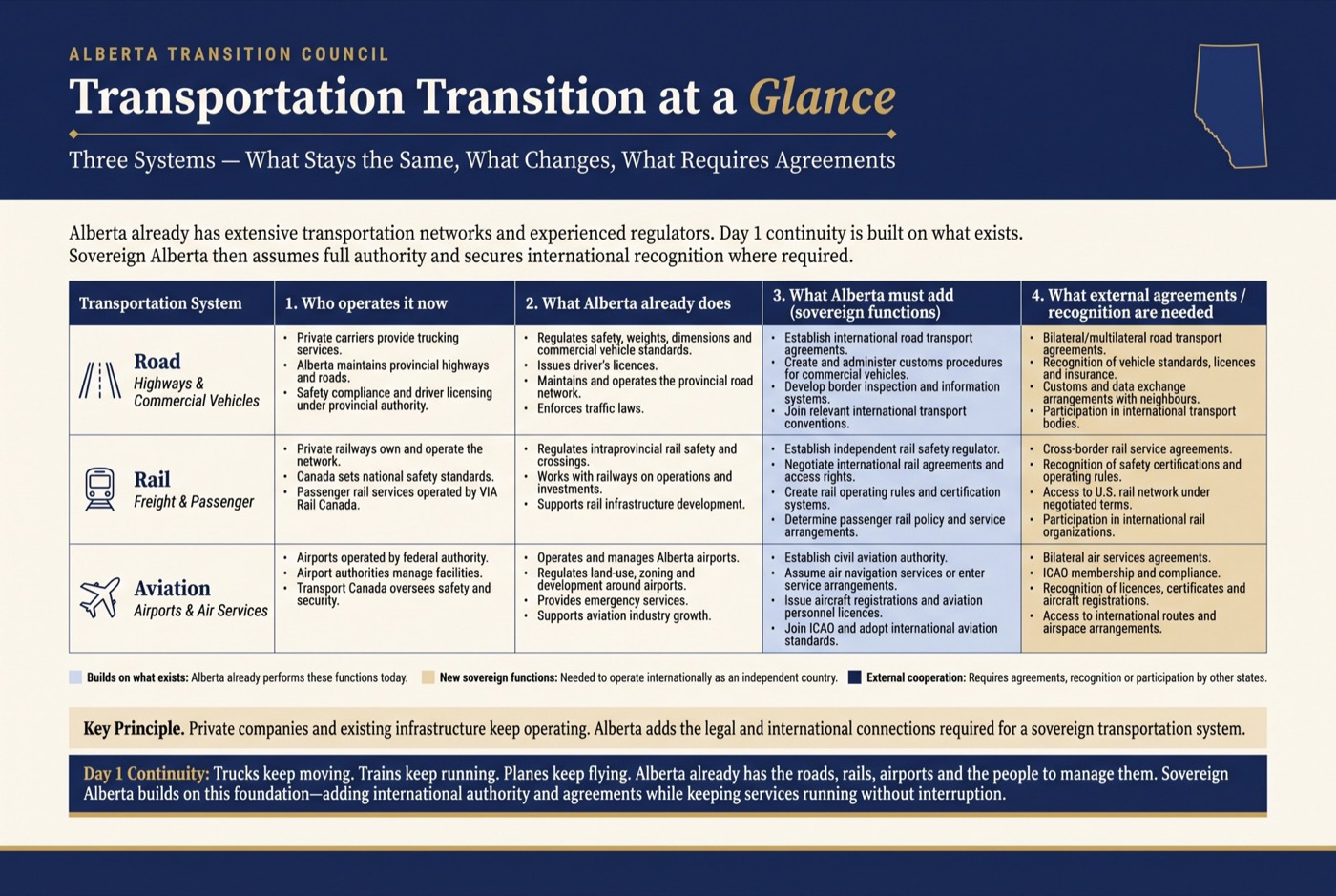
Transportation is not one government service. Roads are largely public infrastructure, while most trucks, trains, aircraft, terminals and logistics businesses are privately or locally operated. Alberta already owns and manages the provincial highway system, licenses drivers and vehicles and performs substantial commercial-carrier regulation. Alberta also has its own railway regulatory base. In aviation, the two principal international airports are already operated by locally based airport authorities incorporated under Alberta law rather than by Transport Canada. The federal layer around those airports is primarily land/lease, regulation, aviation security, border and international-airspace responsibility, not routine terminal or runway management.
The practical result is that the transition should be mode-specific. Alberta needs to supply the legal authority to facilitate cross-border trucking and main-line rail, preserve safety and insurance recognition, and make the new international boundary workable. For aviation, Alberta would become the state counterpart for the International Civil Aviation Organization (ICAO) system and would need internationally credible aviation law and oversight, while the same airport authorities and potentially the same air-navigation provider continue the visible service.
Alberta would need to enact legal authority for main-line rail safety, economic fitness and shipper remedies, crossings, operating rules, inspections and enforcement. Alberta would need to transition the existing federal specialist capacity working in support of rail in Alberta into Alberta administration. Trucking is a narrower domestic transition because Alberta already performs much of the carrier-facing regulation; the important step is converting present extra-provincial status into international status and obtaining recognition from Canada and the United States. Aviation remains a mix of new sovereign regulation and negotiated continuity for airport land, air navigation, route rights and international recognition.
The Day 1 independence standard is therefore not institutional completeness. It is that trains, trucks and aircraft can continue operating safely, lawfully and predictably while the permanent policy regime matures.
The updated air-road-rail plan deliberately avoids creating separate agencies for every mode. A temporary Transportation Transition Office within Alberta Transportation and Economic Corridors coordinates readiness, Canada/United States/International Civil Aviation Organization negotiations and cross-modal dependencies, but it does not operate railways, trucking companies, airlines, airports or air traffic control. Permanent safety regulation, economic adjudication and accident investigation remain separated so the same body is not operator, regulator and investigator at once.
| Function | Planned Alberta owner | Why the separation matters |
|---|---|---|
| Transition coordination | Transportation Transition Office | Coordinates the program and external schedules; does not operate carriers or infrastructure. |
| Rail safety | Expanded Rail Safety Directorate | Extends Alberta’s existing provincial rail platform to all railways in Alberta. |
| Truck/carrier safety | Existing Carrier and Vehicle Safety functions | Reuses Alberta licensing, carrier fitness, inspection and enforcement capacity. |
| Civil aviation safety | Alberta Civil Aviation Authority (ACAA) | Independent sovereign aviation regulator for certification, licensing, security oversight and international compliance. |
| Economic disputes | One independent transport adjudicator with modal panels | Handles rail fitness/service remedies and aviation licensing/passenger matters without duplicating tribunals. |
| Occurrence investigation | Independent Alberta Transportation Safety Board | Investigates causes and safety lessons separately from regulators and operators; a Canadian service bridge can be used temporarily. |
| Air-navigation delivery | Arm’s-length contracted service arrangement initially | Keeps service provision separate from ACAA regulatory oversight; NAV CANADA continuity is the preferred bridge if agreed. |
| Customs/border enforcement | Alberta Sheriffs Police Service (ASPS) Division 3 | Transport states operational requirements, while the border domain owns front-line customs and law-enforcement execution. |
18.1 Road Transportation
Alberta's provincial and municipal road network does not have to be recreated. Highway construction, maintenance, snow clearing, traffic engineering and most ordinary road operations remain with the same Alberta and municipal institutions. The constitutional change is concentrated at the boundary and in the legal authority applied to cross-border commercial movement.
The new border must be planned as a corridor system rather than simply a set of booths. High-volume freight crossings need customs processing, inspection areas, advance commercial information, brokers, carrier identifiers, transit procedures, payment and release messaging, dangerous-goods capacity, contingency routes and operating hours matched to freight demand. Lower-volume crossings can use different service levels, but the network as a whole must be tested from shipper tender to delivery.
18.2 Commercial Vehicle Regulation
The most practical Day 1 rule is no mass re-licensing. Existing Alberta Safety Fitness Certificates should remain valid, with carriers now authorized to operate outside Alberta mapped into an interim international status. Carrier profiles and compliance histories should remain linked to the same operator. Existing commercial driver licences should be deemed continuing Alberta state licences without a new skills test solely because sovereignty changed; medical status, endorsements, restrictions, convictions and training records should carry forward.
Alberta should initially preserve National Safety Code (NSC)-equivalent rules for carrier fitness, driver qualifications, vehicle maintenance, inspections, cargo securement, hours of service and audits. Commercial-vehicle inspection certificates should remain valid for their normal term, and Alberta should preserve its network of licensed private inspection facilities. Weight, dimension, registration and oversize/overweight permit systems can continue under Alberta law, with reciprocal recognition negotiated for cross-border routes.
Vehicle manufacturing standards and recalls should be handled by recognition rather than duplication on Day 1. Alberta can continue accepting Canadian and United States vehicle standards and manufacturer recall notices, recognize compliant vehicles already in commerce, and name a responsible Alberta official to receive and publish recall information. The updated transportation analysis specifically defers creation of a permanent Alberta vehicle-standards and recall regime until a future Legislature decides whether one is necessary. This avoids using scarce transition staff to recreate a system whose technical outputs can continue to be recognized.
External recognition is critical. Alberta should obtain written Canada and U.S. recognition of commercial driver and carrier credentials, maintain interoperable hours-of-service and electronic-logging data, and seek successor or continuing participation in the International Registration Plan (IRP) and International Fuel Tax Agreement (IFTA). Temporary trip-permit and fuel-tax procedures can serve as a fallback, but they are less efficient than uninterrupted participation.
18.3 Rail Transportation
The two mainline railways that are currently regulated by the federal government, Canadian National Railway Company (CN) and Canadian Pacific Kansas City (CPKC), both currently operate across international borders in multiple countries.
The existing Alberta rail-safety platform can be expanded into a Rail Safety Directorate or equivalent expert regulator with authority over operating fitness, rules, safety-management systems, track and equipment, operating practices, crossings, employee qualifications, dangerous goods, inspections, enforcement and emergency orders. Existing Canadian certificates, insurance evidence, approved rules and technical standards can be recognized for an interim period, subject to Alberta verification and safety powers. Crews should not have to learn a new rulebook simply because the legal regulator changed.
Safety regulation alone is not enough. Alberta also needs a lean adjudicative home for the economic functions now supplied federally, including operating fitness, insurance, service complaints, access and crossing disputes, and line-transfer or discontinuance matters. Existing federal proceedings involving Alberta trackage should either be completed by the existing body or transferred under agreed rules so shippers and railways do not lose a forum at the cutover.
VIA Rail also currently provides interprovincial passenger rail service through Alberta. That service need not be disrupted by independence. Alberta, Canada and VIA Rail could establish arrangements before Day 1 of independence allowing existing passenger services to continue, including access to railway infrastructure and stations, operating rights, safety recognition and any necessary border or customs procedures. Longer-term passenger rail arrangements could then be addressed through normal transportation agreements.
Rail operations cross boundaries continuously. Canada-Alberta arrangements should recognize crew qualifications, rolling-stock and track inspections, operating rules, dispatching arrangements, interchange records and through service so a train does not require duplicative inspection or unnecessary crew substitution merely because it crosses the new boundary. Privately owned railway property should remain outside the general federal-asset division unless a genuine Crown interest is involved.
18.4 Aviation
Aviation is federally regulated today, but it is not operated as one federal government system. Transport Canada establishes and enforces most civil aviation safety and security rules, including aircraft certification and airworthiness, aircraft registration, airport and air-operator certification, and pilot and maintenance licensing. These rules apply across the aviation sector, including passenger airlines, cargo and freight operators, charter and air-taxi services, private and business aircraft, flight training and general aviation. Aircraft accidents and serious incidents are investigated separately by the independent federal Transportation Safety Board (TSB).
Other aviation functions are already performed by separate organizations. Provincial airport authorities operate the major airports; airlines and private companies operate aircraft and ground services; NAV CANADA provides air traffic control and navigation services; CATSA manages passenger and baggage screening through private contractors; and CBSA processes international travellers and goods. This existing separation makes aviation well suited to a continuity-based transition.
The objective is therefore not to recreate Alberta's aviation industry. The airports, airlines, aircraft, pilots, maintenance organizations, air traffic controllers and other skilled personnel already exist. The transition task is to replace or bridge the federal legal and regulatory functions and secure continued international recognition before Day 1 of independence.
18.4.1 Who owns and operates Alberta's airports
The federal government does not own or operate Alberta's airport system generally. Most Alberta airports are municipally, regionally or privately owned and can continue under their existing ownership and management.
The principal federal property issues are concentrated at the major Calgary and Edmonton facilities. Calgary Airports operates Calgary International Airport and Springbank Airport under long-term arrangements with the Government of Canada. Edmonton Airports operates Edmonton International Airport under a long-term federal ground lease. These airport authorities are independent, not-for-profit corporations operating within Alberta's regional airport authority framework; they are not federal departments or Crown corporations.
Villeneuve Airport is different. Although originally built by Transport Canada, the federal government sold it to Edmonton Airports in 2000. Accordingly, Villeneuve does not present the same federal-land issue as Edmonton International.
This distinction simplifies the transition. The organizations that operate Alberta's principal airports already exist in Alberta. The main property issue is therefore the continuation, transfer or replacement of federal lease and ownership interests at the limited number of airports where they remain.
18.4.2 Airport operations and private aviation can continue
Airport authorities principally operate and maintain the physical airport: runways, taxiways, terminals, roads, facilities, commercial leases and capital projects. Airlines and private contractors separately provide aircraft operations, baggage handling, fuelling, catering, maintenance and many other services.
Independence therefore does not require Alberta to create a government department to operate airports. Existing airport authorities, municipal airports and private airports can continue operating. For federally owned or leased airport property, Alberta and Canada would need to settle the applicable leases or land interests before Day 1 of independence. Options could include continuation of the existing lease for a transitional period, assignment to an Alberta public owner or transfer of the underlying federal property as part of the broader asset settlement.
The same continuity principle applies to aircraft operators. Passenger airlines, cargo carriers, charter operators, air taxis, flight schools and private aircraft owners should continue using their existing aircraft, personnel, facilities and commercial arrangements, subject to recognition under Alberta's new aviation framework.
18.4.3 Air traffic control and navigation
NAV CANADA, not Transport Canada, operates Canada's civil air-navigation system. It is a private, not-for-profit corporation providing air traffic control, flight information, aeronautical information and navigation services to passenger airlines, cargo and charter operators, private aircraft and general aviation.
The preferred Day 1 independence arrangement would be an agreement permitting NAV CANADA to continue providing air-navigation services in Alberta while Alberta assumes the sovereign legal responsibilities associated with its airspace. This would allow existing controllers, systems, navigation aids and operating procedures to continue without unnecessary disruption.
18.4.4 Passenger and baggage screening
Aviation security is also divided between regulation and operations. Transport Canada establishes the regulatory framework, while CATSA, a federal Crown corporation, delivers passenger, carry-on and checked-baggage screening largely through private screening contractors.
The preferred transition would allow CATSA and its existing contractors to continue screening in Alberta for a defined period while Alberta establishes its own legal and oversight framework. Alternatively, Alberta could contract directly with qualified screening providers using the existing workforce and infrastructure.
The objective is continuity of security standards, equipment and trained personnel rather than an unnecessary Day 1 replacement of functioning screening operations. Customs and immigration functions for international travellers would be addressed through the separate border transition described in Chapter 21.
18.4.5 The sovereign functions Alberta must establish
The principal new institutional requirement is a sovereign civil aviation regulator, proposed here as the Alberta Civil Aviation Authority (ACAA). It would assume responsibilities now performed principally by Transport Canada, including:
aircraft registration, certification and airworthiness;
airport and air-operator certification;
pilot and aviation-personnel licensing;
oversight of passenger, cargo, charter, private and other aircraft operations;
maintenance and safety standards;
aviation-security regulation;
dangerous-goods and enforcement functions; and
international aviation representation.
Existing Canadian certificates, licences, aircraft registrations and technical rules should be recognized for a defined transition period wherever practicable. Pilots, airlines and aircraft owners should not have to obtain entirely new credentials simply because the sovereign regulator has changed.
Alberta would also require an independent aviation-occurrence investigation function. Canada presently separates this responsibility from Transport Canada through the Transportation Safety Board. Alberta could establish an independent accident-investigation body or negotiate transitional investigative services with the TSB while building its own capacity. Maintaining independence between the safety regulator and accident investigator would preserve the existing institutional safeguard.
18.4.6 International recognition and technical continuity
Civil aviation depends heavily on international recognition and agreements. The global framework is established by the 1944 Convention on International Civil Aviation (Chicago Convention) and the International Civil Aviation Organization (ICAO). International route and market-access rights are then established through air transport agreements between countries. For Alberta, particularly important existing arrangements include the 2007 Air Transport Agreement between Canada and the United States, commonly referred to as the Canada–U.S. Open Skies Agreement, and the Canada–European Union Comprehensive Air Transport Agreement, together with Canada's extensive network of bilateral air transport agreements with other countries. These agreements govern matters such as overflight, international routes, airline access, passenger and cargo services, safety and security.
Before Day 1 of independence, Alberta would therefore need to obtain the necessary international recognition and negotiate continuity, accession or successor arrangements, as appropriate, with Canada, the United States and other aviation partners. Alberta would also need to participate in the ICAO framework and maintain internationally recognized aviation safety, security and certification standards so existing international passenger, cargo, charter and other air services can continue without disruption.
Less visible technical systems must also continue. Pilots and airlines require authoritative aeronautical information, flight notices, airspace restrictions, navigation procedures, aircraft records and licensing information. These systems should be transferred, replicated or continued by agreement before Day 1 so that a legal or information gap does not interrupt otherwise functioning flights.
18.4.7 Day 1 aviation standard
The practical Day 1 test is simple. A traveller should be able to drive to the same Calgary or Edmonton airport, check in with the same airline, pass through a lawful security checkpoint, board at the same gate, use the same runway and air-traffic system, and clear a functioning border process when travelling internationally.
The same principle applies to cargo aircraft, charter flights, private aircraft and smaller airports across Alberta. Behind those familiar operations, the regulator, federal leases, screening authority and international legal arrangements may have changed. The purpose of the transition plan is to make those legal changes while keeping the aviation system operating safely and continuously.
18.5 Transportation Safety
Rail, trucking and aviation require a clear separation between operating regulation and independent occurrence investigation. Alberta should establish an independent transportation-safety investigation function, with a time-limited Transportation Safety Board service agreement if Canada is willing, so serious rail and aviation occurrences continue to receive technically credible investigation while Alberta builds permanent capacity.
Dangerous-goods rules should remain substantially equivalent on Day 1 across rail and highway modes. Classification, packaging and containment, documentation, training, security, emergency-response plans, permits and enforcement need sovereign legal authority but should not diverge abruptly from the standards carriers and emergency responders already use. Cross-border emergency contacts and mutual-aid procedures should be tested before cutover.
18.6 Interjurisdictional Transportation
A Canada–Alberta Transportation Continuity Agreement should be a priority schedule to the broader constitutional and economic settlement. Its surface schedule should cover reciprocal train and truck transit, bilateral carriage, cabotage rules, credential and inspection recognition, railway interchange and dispatch, terminal and port access, customs transit, insurance, dangerous goods, emergency cooperation and data. Its air schedule should address trans-boundary traffic rights, overflight, certificate recognition, safety/security cooperation and simplified passenger and cargo processing where achievable. Shared schedules can cover dangerous goods, safety investigation, customs and data. One integrated agreement reduces the risk that rail, trucking and aviation negotiate inconsistent rules for the same border and corridor system.
The United States requires a separate recognition workstream. Alberta should confirm commercial-driver and carrier recognition, customs processing, trusted-trader arrangements, IRP/IFTA participation, and rail interchange or equipment requirements rather than assume that rights currently available to a Canadian province will automatically transition to independence.
18.7 Border-Crossing Infrastructure
Commercial freight depends on systems as much as physical lanes. Customs and border readiness includes advance data, risk assessment, broker connectivity, carrier codes, payment, release messages, inspection protocols, bonded or in-transit procedures, trusted-trader status, agriculture or dangerous-goods interfaces, and an outage fallback. A border facility is not operationally ready merely because a building and inspection lane exist.
Rail crossings need the same end-to-end approach. Customs data and inspection rules must fit railway operations without forcing unnecessary train stops or breaking interchange. Highway port staffing and inspection capacity should be based on freight volumes and commodity risks, with redundancy for major energy, agriculture, food and industrial corridors.
18.8 Federal Transportation Assets and Responsibilities
The asset transition should distinguish private transportation property from federal property or statutory interests. Private railway rights-of-way, yards, locomotives, rolling stock, trucks, terminals, warehouses, leases, mortgages and commercial contracts do not become Alberta public assets merely because the sovereign boundary changes. Federal airport lands, leases, inspection facilities, records, equipment or statutory rights require specific treatment under the debt-and-assets process.
Selected references from white papers
- Government of Alberta: Railway (Alberta) Act and provincial railway operating, incident-reporting and audit materials.
- Government of Canada: Railway Safety Act; Canada Transportation Act; Motor Vehicle Transport Act; and federal dangerous-goods framework.
- Transport Canada: National Safety Code; Commercial Driver Hours of Service Regulations; Canadian Aviation Regulations.
- Convention on International Civil Aviation (Chicago Convention) and ICAO Annexes, including safety, airworthiness, facilitation, air navigation, security and dangerous-goods standards.
- International Registration Plan and International Fuel Tax Agreement.
- NAV CANADA; Canadian Air Transport Security Authority; and Transportation Safety Board of Canada: current aviation and transportation operating frameworks.