Most banking activity experienced by Albertans is already delivered by private financial institutions, not by a federal department. The branch, mobile app, mortgage, credit card, commercial loan and back-office operations belong to banks or credit unions. The federal layer is principally the legal charter and bank safety-and-soundness framework for banks, federal deposit insurance for eligible deposits, national payment and clearing arrangements, and central-bank liquidity. Alberta also already has ATB Financial and a provincially regulated credit-union system including 11 provincially incorporated credit unions. The provincially created Alberta Credit Union Deposit Guarantee Corporation (CUDGC) currently guarantees 100% of deposits at Alberta credit unions.
Large Canadian banks also operate across national borders in the United States and other countries serving citizens of those countries. That experience is relevant because it shows that a bank can serve customers in more than one sovereign jurisdiction without moving its core technology or rebuilding every branch. It does not mean legal continuity is automatic: an Alberta banking licence, bank safety-and-soundness rules, deposit protection, clearing access and liquidity arrangements would still have to be settled.
Banking has at least four different layers. Private banks and credit unions provide the customer-facing service: accounts, loans, cards, branches, mobile applications and business banking. Regulators supervise whether institutions are legally authorized and financially sound. Deposit-protection arrangements protect eligible deposits if an institution fails. Payment and settlement systems move money between institutions, while a central-bank or emergency-liquidity function provides temporary cash to otherwise solvent institutions during stress.
Consider a normal purchase through a debit-card. The customer uses a card issued by a private bank; messages pass through a payment network; the customer's bank and the merchant's bank settle the amount; and both institutions operate under regulatory and deposit-protection rules. A change in the federal regulator arising from sovereignty does not require replacing the shop, the card terminal or the bank's computer system. It does require lawful banking authority, continued connection to payment systems and a credible safety net.
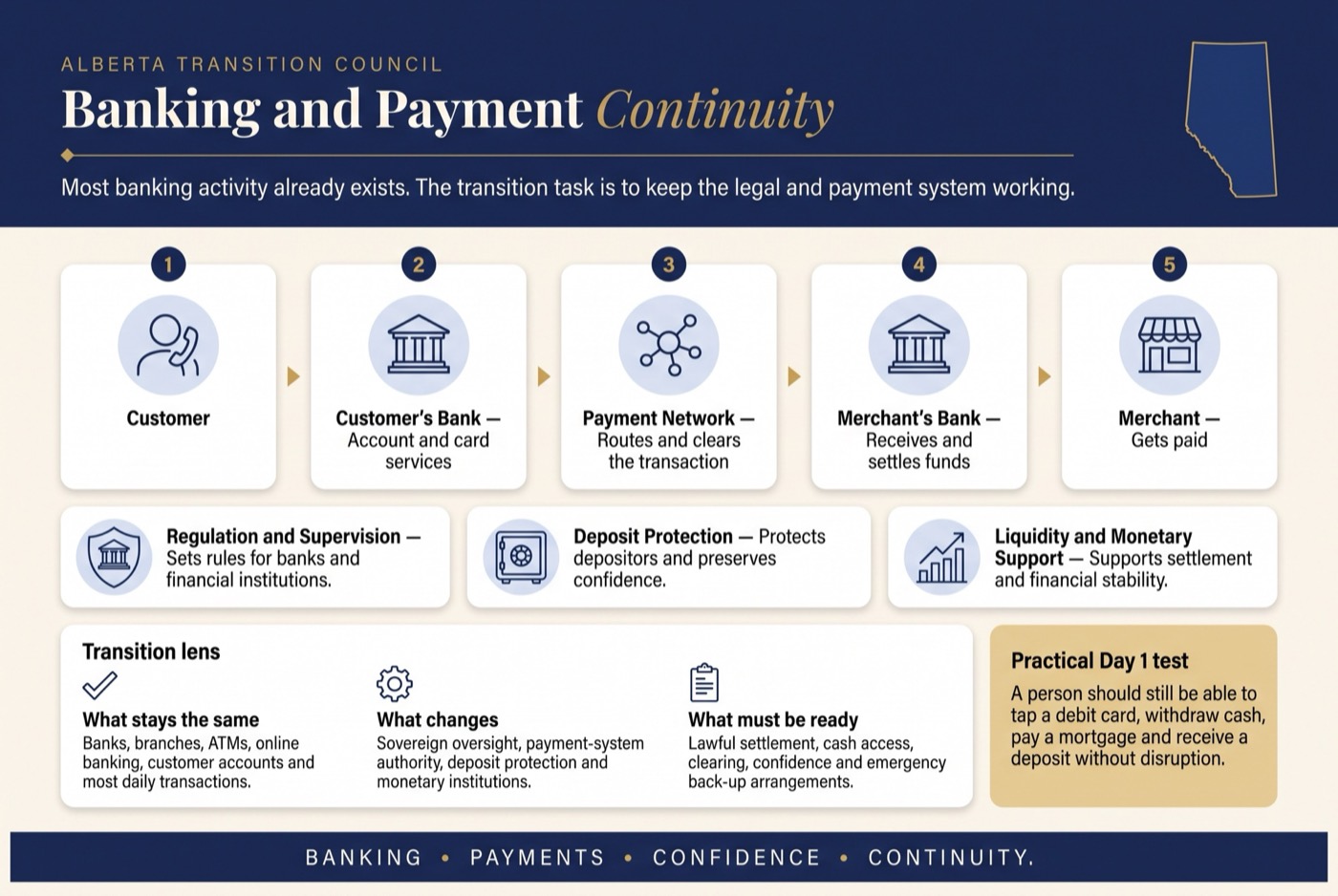
A bank branch is therefore only the visible front end of a much larger system. The teller, mortgage specialist and mobile app work for the bank; other institutions behind the scenes supervise the bank, protect eligible deposits, clear payments, supply liquidity and, in some mortgages, insure the lender against default. None of those institutions is interchangeable with the bank itself.
| Institution / layer | What it does today in simple terms | What a transition actually has to solve |
|---|---|---|
| Private bank or credit union | Holds customer accounts, makes loans and mortgages, issues cards and operates branches and apps. | Keep customer contracts and accounts usable; give the institution lawful Alberta authority to continue operating. |
| Office of the Superintendent of Financial Institutions (OSFI) | Federal prudential supervisor for federally regulated banks and certain other financial institutions. It watches capital, risk and safety-and-soundness requirements. | Alberta needs its own prudential authority for institutions under Alberta jurisdiction, or a negotiated supervisory bridge during transition. |
| Canada Deposit Insurance Corporation (CDIC) | Federal Crown corporation that protects eligible deposits at member institutions up to the statutory coverage rules. | Existing coverage and successor Alberta deposit protection must be implemented. |
| Payments Canada | Runs core Canadian payment-clearing and settlement systems used behind cheques, electronic transfers and other payments. | Alberta needs continued access or an interoperable replacement path. |
| Bank of Canada | Canada’s central bank; among other functions it supports Canadian-dollar liquidity and financial-system stability. | If Alberta banks continue using Canadian dollars, liquidity and settlement arrangements must be negotiated or replaced with credible Alberta facilities. |
| Canada Mortgage and Housing Corporation (CMHC) | Federal Crown corporation involved in mortgage-default insurance, housing finance and securitization, and housing programs. | Existing insured mortgages and funding channels should be bridged where agreed while Alberta prepares a successor housing-finance capacity if needed. |
This distinction explains why banking continuity is mostly a regulatory interface problem. Alberta does not need to create new bank branches. It needs to make sure the legal licence, supervision, deposit protection, payment clearing, liquidity and mortgage-insurance layers remain credible around the existing private banking business.
For an ordinary customer, the Day 1 of independence result would be that the same account number, debit card, mortgage payment, payroll deposit and online login continue to work. Behind that apparent continuity, Alberta would need to decide the applicable currency, guarantee deposits under its jurisdiction, supervise institutions, preserve or replace access to payment systems, and provide emergency liquidity to solvent institutions.
8.1 Currency Options
The updated banking analysis uses continued use of the Canadian dollar as the initial Day 1 independence planning assumption because it minimizes contract, pricing and consumer disruption. Other possibilities—including use of the U.S. dollar, dual-currency arrangements or a future Alberta currency—remain longer-term or contingency choices. This transition plan does not select a permanent currency regime; it separates the immediate continuity decision from the later monetary-policy decision to be made by the independent Alberta government.
8.2 Transitional Use of the Canadian Dollar
Continued use of the Canadian dollar would minimize consumer and contract conversion at the outset. In order to guarantee access to Canadian payment infrastructure or central-bank liquidity, those operational arrangements must be negotiated separately.
8.3 Monetary Policy Options
Using another country’s currency would mean importing that country’s monetary policy rather than setting an independent policy rate. A sovereign Alberta currency could create policy autonomy later but would require a substantially more mature central-bank, reserve, payments and confidence framework than the Day 1 independence transition requires.
8.4 Central Banking or Monetary Authority Functions
The transition plan proposes an Alberta Monetary Authority responsible for financial stability, liquidity, payment oversight, bank supervision coordination and currency management. The permanent institutional form—central bank, monetary authority or a different model—can be decided after the transition architecture is proven.
8.5 Banking Regulation and Supervision
Alberta would need a lawful bank safety-and-soundness regime for banks and other deposit-taking institutions. Existing ATB and credit-union supervision provide a base, while national bank branches would require a clear licensing/grandfathering path and a predictable transition from federal to Alberta oversight.
8.6 Deposit Insurance
The analysis emphasizes public confidence in deposit safety. A transition agreement should clarify continuing federal coverage where applicable and Alberta should have a legally funded backstop for institutions under its jurisdiction. The exact coverage model and limits require actuarial and fiscal validation rather than relying on broad unverified planning assumptions. Alberta already has experience with deposit insurance with the 100% guarantee Alberta provides to Alberta credit unions through the Alberta Credit Union Deposit Guarantee Corporation.
8.7 Payments and Settlement Systems
Payment continuity is a major external dependency. The preferred low-disruption route is negotiated access to existing clearing and settlement systems; the fallback is staged domestic and correspondent-bank capability. Both require technical testing well before Day 1 of independence.
8.8 Financial-Market Regulation
Securities, market conduct, anti-money-laundering interfaces, payments compliance and cross-border correspondent banking must remain credible to financial institutions outside Alberta. Existing Alberta securities capacity through the Alberta Securities Commission can be reused while federal functions are mapped and replaced or bridged.
8.9 Financial Stability and Emergency Liquidity
A stable banking system also requires a source of emergency liquidity. Even a financially sound bank or credit union can face a temporary cash shortage if unusually large numbers of customers withdraw deposits at the same time or if normal funding markets are disrupted. A lender-of-last-resort facility provides short-term funding in those circumstances so that a temporary liquidity problem does not become an unnecessary bank failure.
During the transition, Alberta should therefore have a clearly funded and operational liquidity backstop available to qualifying financial institutions. As part of the transition, this could include continued access to Bank of Canada liquidity or a negotiated credit facility. Alberta should also prepare its own fallback through an interim Alberta monetary authority or central bank, supported where necessary by commercial credit arrangements with major financial institutions outside Canada. These are alternative arrangements that should be negotiated and tested before Day 1 of independence rather than assumed to be available.
8.10 Housing Finance, Mortgages and Real Estate Market Continuity
For homeowners, homebuyers, real estate professionals, developers and lenders, the starting point is that the visible real estate market is not a federal government service. Homes remain where they are. Alberta Land Titles already records ownership and registered mortgages. Real estate and mortgage-broker licensing are already regulated in Alberta. Banks, credit unions, appraisers, lawyers, builders and brokerages are private or provincial actors.
The main federal transition issue sits behind that market in housing finance—especially mortgage-default insurance, mortgage funding and securitization, and federal housing programs. The transition objective is therefore not to rebuild Alberta’s real estate market. It is to preserve the contracts, titles, licences and financing systems that already work while securing continuity for the federal housing-finance functions on which part of the market depends.
How a home purchase and mortgage work today
A mortgage is a private loan secured against land. A bank, credit union or other lender advances the money and registers a mortgage against the property’s title. Alberta Land Titles records the ownership and mortgage, while Alberta-regulated professionals handle the sale, financing and closing. Those core arrangements do not need to be recreated because Alberta’s constitutional status changes.
For transition planning, the key principle is continuity: existing titles, mortgages, purchase contracts, deposits, appraisals, licences and closing procedures should remain effective unless they are lawfully changed. Transactions already underway when Day 1 independence occurs should be allowed to finish under clear continuity rules.
What CMHC does—and what a “CMHC mortgage” means
Canada Mortgage and Housing Corporation (CMHC) is a federal Crown corporation. It does not normally lend the money for a homebuyer’s mortgage. Instead, CMHC provides mortgage-default insurance to approved lenders. The insurance protects the lender if the borrower defaults; it does not remove the borrower’s obligation to qualify for and repay the mortgage.
Mortgage insurance is important because it allows qualified buyers to obtain financing with smaller down payments and can help lenders offer insured mortgages on more favourable terms. CMHC is not the only mortgage insurer. Private insurers such as Sagen and Canada Guaranty also operate in the Canadian market. CMHC also supports lender funding through securitization programs and plays an important role in multi-unit housing finance and federal housing programs.
These functions do not all have to be transferred in the same way. Some may be continued temporarily by agreement with Canada or CMHC; others may be provided by private insurers or an Alberta successor. The important Day 1 question is not which institution carries the familiar label. It is whether homeowners, buyers and lenders have a reliable and legally valid way to keep existing mortgages in force and finance new ones.
Existing mortgages on Day 1 of independence
Existing mortgages on Alberta property will remain valid and enforceable after Day 1 of independence. A homeowner will continue making payments to the same lender under the same mortgage contract and should not be required to re-qualify, refinance or replace the mortgage merely because Alberta becomes independent. The registered mortgage will remain on title until it is discharged in the ordinary way.
For mortgages already insured by CMHC, the preferred Canada–Alberta settlement should preserve the existing insurance coverage and claims-administration arrangements. Mortgage transactions, renewals and property sales already underway at Day 1 should likewise continue under clear contract, financing and land-title continuity rules.
Homebuyers and new mortgages after Day 1 independence
The more important forward-looking question is whether qualified buyers will continue to have access to mortgages after Day 1, including insured mortgages for buyers with smaller down payments. The transition plan should ensure that at least one workable mortgage-insurance route is operating before independence takes effect.
The least disruptive approach would be to negotiate a temporary arrangement under which CMHC continues servicing existing insured mortgages and, if agreed, continues selected mortgage-insurance or housing-finance services for a transition period. Alberta should also prepare a domestic fallback so that new mortgages can continue to be insured if CMHC eligibility ends. That fallback could involve an Alberta housing-finance successor, private mortgage insurers, a government guarantee structure, or a staged combination of those approaches.
There is no operational reason to force an overnight transfer of every existing CMHC-insured mortgage. A practical arrangement could leave the existing insured portfolio with CMHC while new Alberta arrangements are phased in. This would reduce the number of contracts and data files that must be transferred at once and give lenders and markets time to adjust.
Mortgage funding and multi-unit housing
Mortgage insurance is only part of housing-finance continuity. Banks and other lenders also rely on national funding and securitization systems supported by CMHC. Before Day 1 of independence, lenders should know whether Alberta mortgages remain eligible for existing funding channels during a transition period and what alternative funding arrangements are available if those channels change. The objective is to avoid a situation in which mortgages remain legally valid but lenders become uncertain about how to fund new Alberta lending.
Ordinary commercial mortgages are private contracts and should generally continue under normal contract and land-title continuity rules. Multi-unit residential housing requires more specific review because CMHC can provide mortgage insurance and federal project financing. Existing Alberta projects should therefore be identified in advance so that their insurance, funding, claims and administration either continue under an agreement or move to a defined Alberta replacement.
Day 1 housing-finance readiness
The housing market should not be treated as ready merely because existing mortgages remain legally enforceable. Before Day 1, the Government should be able to demonstrate that the following practical arrangements are in place:
| Readiness item | Minimum practical result |
|---|---|
| Existing mortgages | Contracts remain enforceable; no automatic acceleration, refinancing or requalification merely because sovereignty changes. |
| Existing CMHC-insured mortgages | Coverage, claims, premiums, data and servicing arrangements are confirmed for Alberta properties already insured. |
| New homebuyers | At least one operational route exists for insured mortgages—through temporary CMHC eligibility, private insurers, an Alberta successor or a combination. |
| Lender funding | Banks and other lenders know how new Alberta mortgages can be funded and which securitization or alternative funding channels remain available. |
| Land Titles, closings and professionals | Transfers, mortgage registrations, discharges and transactions already in progress continue; existing Alberta licences and brokerage authorities remain in force. |
| Multi-unit housing | Existing insured projects have a named administrator and payment/claims route, and new applications have a defined pathway. |
Transition conclusion for housing finance
Housing finance matters because it touches one of the largest financial commitments most families make. But the practical starting point is clear: the house, title, lender, mortgage contract and Alberta’s real estate professionals already exist. The transition work is behind the scenes—preserving contracts, continuing or replacing CMHC-related insurance and funding, and maintaining clear routes for new mortgages and multi-unit projects. If those arrangements are ready before Day 1 of independence, homeowners will make the same payments, sellers should transfer title normally, and qualified buyers should still be able to obtain financing. That is the practical standard for housing-finance continuity.
Selected references from white papers
- Government of Canada: Bank Act.
- Bank of Canada: Payment Clearing and Settlement Act oversight and designated payment-system materials.
- Payments Canada: Lynx and Automated Clearing Settlement System (ACSS).
- Canada Mortgage and Housing Corporation: mortgage insurance, securitization and housing-finance programs.
- Canada Deposit Insurance Corporation; ATB Financial; and Credit Union Deposit Guarantee Corporation: deposit-protection frameworks.