That distinction is important in considering an Alberta transition. The Day 1 independence objective is therefore straightforward: the right person continues to receive the right pension amount through a tested payment channel, while any longer-term issues involving administration, assets or successor arrangements are worked out separately.
Pension and public-payment systems are often perceived as a single federal cheque-writing function. Operationally, they are a combination of legal entitlements, contribution histories, beneficiary data, payment calculations, banking instructions, tax information, call-centre service and long-term asset and liability management. Alberta residents already receive payments into ordinary bank accounts; the physical delivery channel is therefore not the difficult part.
The more important issues are authoritative records and legal responsibility. Canada Pension Plan contribution records and plan assets are governed through federal and provincial legislation, while Old Age Security (OAS), the Guaranteed Income Supplement (GIS) and other payments are separate federal programs. Final settlement of pension assets or administrative responsibilities can take longer than the need to make the next scheduled payment.
Pension and retirement-income systems are easier to understand if contributory pensions are separated from general-revenue benefits. CPP is a contributory pension: workers and employers make contributions over a person’s working life, and the resulting pension entitlement is calculated under the plan rules. Once earned, that entitlement is not dependent on the recipient continuing to live in Alberta or elsewhere in Canada. OAS and GIS are different programs, financed from general federal revenues and subject to their own eligibility and residence rules. They may arrive in the same bank account, but they are not the same legal or financial program.
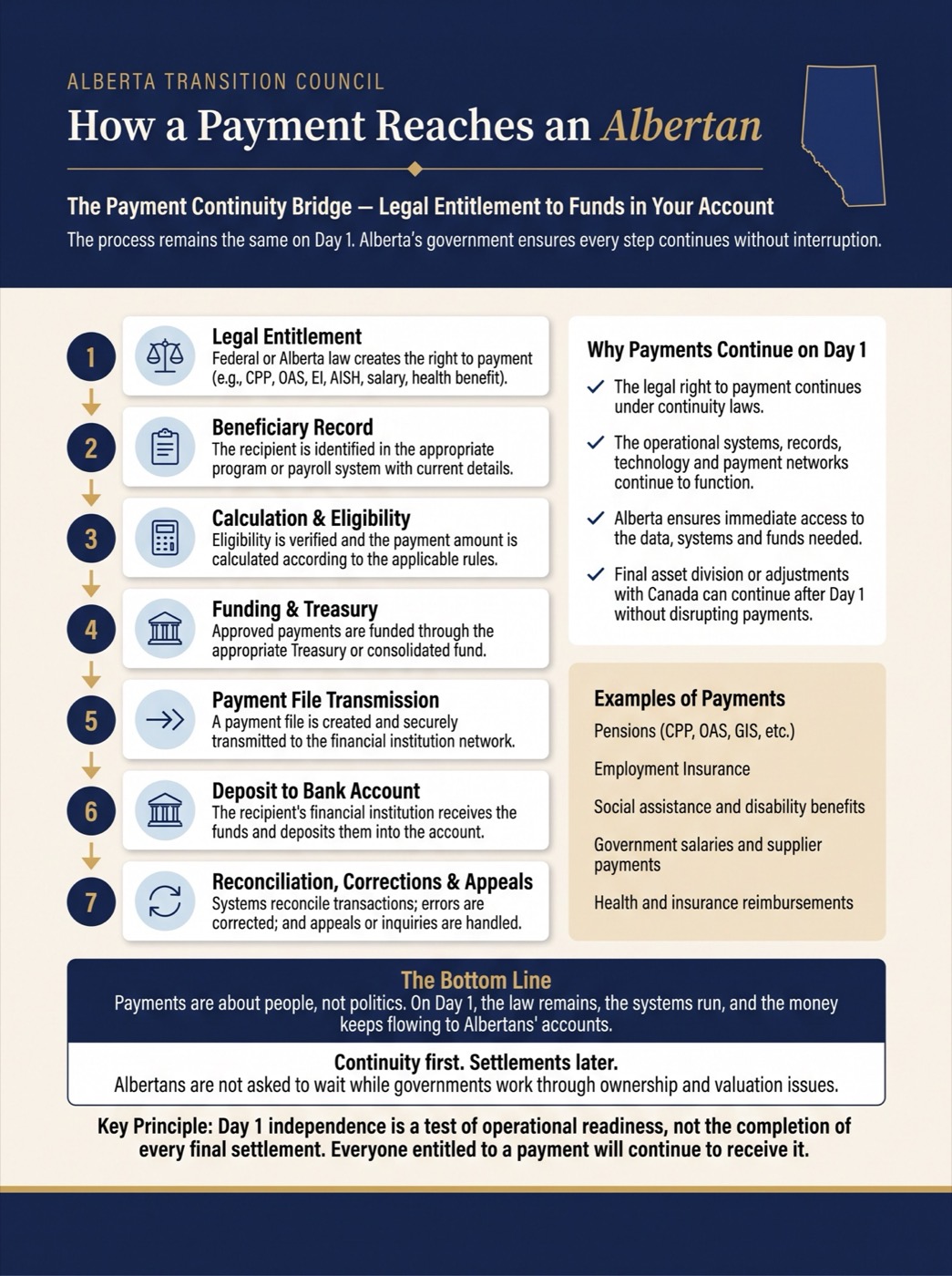
For any scheduled pension payment, four things matter: the person’s legal entitlement, the records used to calculate the amount, the funding source and the payment file that sends the money to the correct bank account. A final division of pension assets can take time, but the next monthly payment cannot. The transition plan therefore puts beneficiary records, payment testing and a bridge payer ahead of final asset settlement. A recipient should not need a new bank account or a new identity merely because the government or institution administering the payment changes.
The white paper pensions analysis therefore separates payment continuity from final pension-plan settlement. Alberta will be capable of ensuring scheduled payments continue from an independently operable beneficiary file, with appropriate reconciliation and appeals, while negotiations concerning CPP participation or a comparable pension plan, asset transfers and reciprocal administration continue.
This is another example where the visible service can remain almost unchanged even though the legal and administrative arrangements behind it may change. For a pensioner, the practical objective is simple: their pension entitlement remains intact and their scheduled payment continues to arrive. The transition risk is not the need to create an entirely new way of paying pensioners; it is ensuring that records, legal authority and payment arrangements are in place so that the correct payment continues without interruption.
10.1 Canada Pension Plan Arrangements
A future Alberta pension plan and any CPP asset/liability transfer require statutory, actuarial and negotiated work. The transition analysis rejects treating CPP assets as ordinary federal Crown assets and recommends a payment bridge until transfer mechanics are complete.
10.2 Treatment of Accrued Pension Entitlements
Accrued contributions, earnings histories, disability records and survivor entitlements must be preserved. Any asset transfer should be matched to associated liabilities, with independent actuarial validation and transparent rules for people who have worked in multiple jurisdictions.
10.3 Establishment of an Alberta Pension Framework
Legislation, collection authority, investment governance, beneficiary administration and appeals would be needed before a permanent Alberta plan operates independently. The transition can begin with legal authority and payment capability even if actuarial settlement takes longer.
10.4 Federal Public-Service Pension Obligations
Federal employee pension rights should be negotiated separately from CPP and general debt. Employees transferring to Alberta institutions may need portability, service-credit recognition and clear responsibility for pre- and post-transition accruals.
10.5 Portability of Pension Benefits
Canada–Alberta portability would reduce disruption for mobile workers and retirees. Agreements should address contribution histories, totalization or reciprocal service credit, taxation of benefits, disability/survivor benefits and people residing on the other side of the new border.
10.6 Transitional Administration and Asset Allocation
The practical core is an Alberta-controlled beneficiary registry, payment file, banking details, identity verification, exception handling, call-centre capacity and appeals. Transition planning should prepare for three records cases: a complete federal data transfer; a partial transfer requiring reconciliation with Alberta, employer and claimant records; and a no-transfer fallback using lawful reconstruction and claimant attestation. Repeated payment rehearsals should occur before Day 1 of independence so the first real pension cycle is not the first system test.
10.7 No Missed Pension Payment Standard
A pension transition will be judged first by whether the next payment arrives correctly and on time. No person lawfully entitled to a transition-protected pension immediately before Day 1 of independence should miss a scheduled payment solely because governments have not yet completed an asset or administration settlement.
This standard does not determine the permanent design of an Alberta pension system or prejudge the final allocation of CPP assets and liabilities. It requires legal payer authority, a validated beneficiary file, payment instructions, funding, correction and appeal procedures, and an independently operable fallback.
Selected references from white papers
- Government of Canada: Canada Pension Plan.
- Canada Pension Plan Investment Board: investment mandate, governance and CPP fund administration.