
Customs and border control are federal legal functions today, but their day-to-day execution occurs at real ports of entry using real officers, booths, inspection facilities, computer systems, scanners and commercial processes. CBSA officers working at Alberta airports and the United States border are not physically operating from Ottawa. Similarly, immigration examination at an airport is a local front-line service connected to national databases and federal decision rules.
This is a critical distinction for transition planning. Alberta must create sovereign border and customs authority, but it does not necessarily need to build every crossing facility or train an entirely new workforce from scratch. Existing infrastructure and experienced officers can potentially be transferred, seconded or recruited, while the government changes the legal commission, employer, uniforms, systems access and command.
A border crossing actually contains two different government decisions. Immigration decides whether a person may enter and under what status. Customs decides what goods may enter, what declaration is required and whether tax, duty, inspection, restrictions or enforcement apply. A traveller and a truck can therefore use the same physical port but go through different legal processes. Airports add the same functions for international passengers and cargo.
The booth or inspection lane is only the visible end of a much larger system. Commercial freight normally sends information before arrival so customs can identify the carrier, goods, value, origin and risk. Brokers, payment systems, permits, agriculture or dangerous-goods controls, inspection teams and release messages all have to connect. Alberta can reuse many existing crossing locations and potentially much of the front-line workforce, but the legal authority, data systems and Canada-Alberta operating rules must be ready before the border is truly functional.
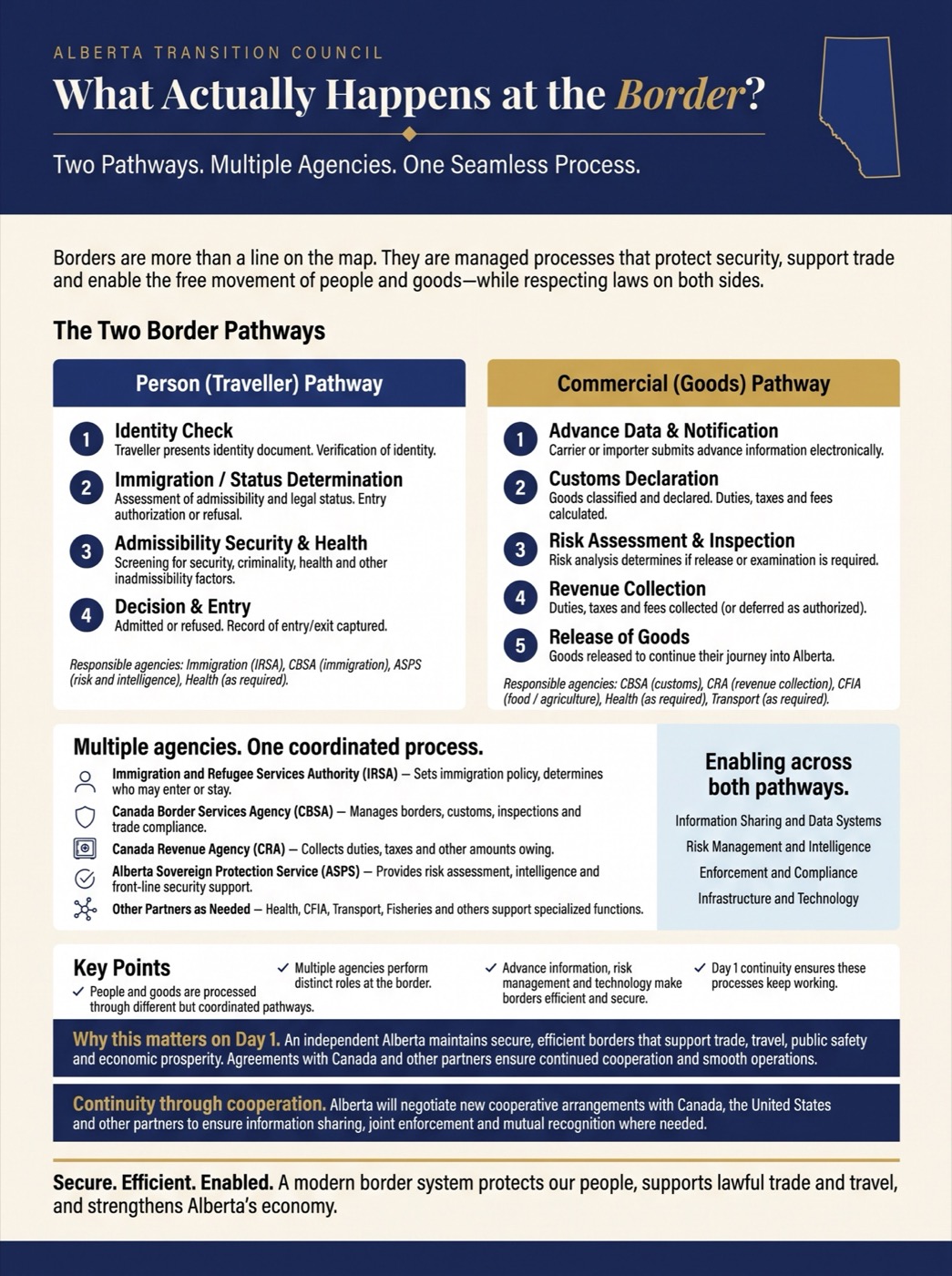
The current transition design assigns front-line customs and border law-enforcement execution to Alberta Sheriffs Police Service (ASPS) Division 3. That does not make Division 3 the owner of every border policy. Trade owns tariffs, classification and rules of origin; the Revenue Service collects duties and taxes; the civilian immigration authority owns visa/status decisions and protection referrals; agriculture and health regulators own specialized inspection requirements; and International Relations negotiates external customs and mobility instruments. Day 1 of independence succeeds when those separate owners work through one front-line border process.
21.1 Nature of the Canada–Alberta Border
A new international boundary would require legal treatment even if both governments choose a highly open mobility and trade regime. The objective should be to make lawful movement as low-friction as possible while preserving customs, immigration and security control.
21.2 Border-Control Options
Options include jointly coordinated facilities, pre-clearance, trusted-traveller/trader programs and separate Alberta processing. The transition plan should choose the simplest model compatible with the final Canada–Alberta trade and mobility agreement.
21.3 Customs Administration
Customs should be understood as three linked jobs. Trade policy decides tariff classifications, rates and rules of origin. ASPS Division 3 officers execute the law at the border by examining, releasing, referring or seizing goods. The Alberta Revenue Service collects duties and taxes and maintains the revenue record. Keeping those roles separate prevents a reader from assuming that one “customs agency” must contain every policy, tax and law-enforcement function.
21.4 Immigration Controls at Ports of Entry
Border officers require clear authority to verify identity/status and refer immigration decisions to the civilian immigration authority. Existing visas and permits should be recognized during transition, with watchlist and admissibility information-sharing in place before Day 1 of independence.
21.5 Movement of Citizens and Residents
The preferred policy objective is a broad Canada-Alberta mobility arrangement, but border systems must also function if rules are more restrictive. Citizens and residents need clear entry, residence, work and study rules. First Nations mobility requires an additional Indigenous-rights lens: current Canada-U.S. border movement already operates under special statutory rules associated with Indian status and the historic Jay Treaty context, and a new Alberta boundary could cut across reserve access routes, treaty territories and family networks. Section 12 therefore recommends a dedicated Indigenous Mobility Protocol rather than treating these movements as ordinary immigration cases.
21.6 Commercial Border Processing
Major commercial crossings require 24/7 staffing, customs release authority, brokers, payment capability, inspection coordination and real-time escalation. Trade and agriculture analysis treats uninterrupted freight movement as a first-order economic requirement.
21.7 Border Infrastructure
Physical facilities, inspection equipment, information technology (IT), secure communications and land ownership should be inventoried. Existing Canadian border sites may be shared, leased, transferred or duplicated depending on the agreement; the least disruptive workable arrangement should be preferred.
21.8 Joint or Transitional Border Arrangements
A time-limited joint or service-agreement model could preserve current processes while Alberta builds its own capacity. Any agreement should specify command, legal authority, data ownership, service standards, costs, dispute resolution and an exit/renewal process.
Selected references from white papers
- Government of Alberta: Alberta Advantage Immigration Program.
- Canada Border Services Agency: Advance Commercial Information / eManifest commercial-reporting framework.
- FAST and C-TPAT trusted-trader and border-facilitation programs referenced in the Transportation White Paper.