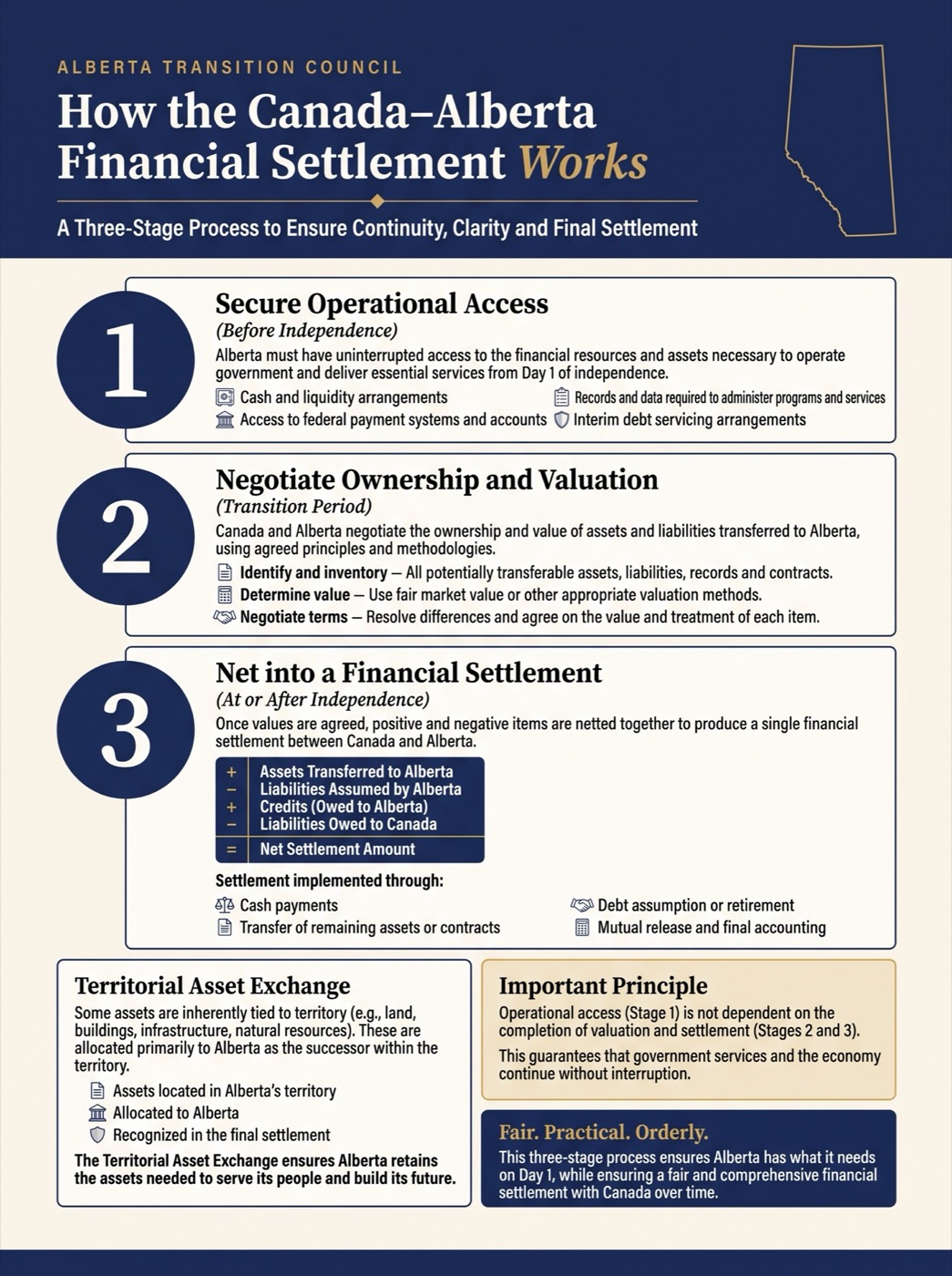
For transition purposes, operational continuity is also more urgent than final ownership. Alberta must be able to use the facilities, records, systems and infrastructure needed to keep government and public services operating even if some questions of ownership, valuation and financial settlement remain unresolved on Day 1 of independence.
Federal assets in Alberta include land, buildings, equipment, infrastructure, records and contractual rights used by many different services. Some are highly visible, such as defence installations, airports, penitentiaries and federal offices. Others are less visible but may be just as important operationally, including databases, maintenance records, leases, licences and contractual files.
Ownership and operation are not always the same thing. A facility may be owned by Canada but operated by another organization under a lease. A service may operate from a federal building while its employees could continue working under a different government. Alberta may need access to a federal database without needing ownership of the computer system that hosts it.
For that reason, final ownership and immediate operational access should be treated as separate questions. A temporary lease, licence, shared-use agreement, service agreement or authenticated copy of records may allow an important service to continue while governments negotiate final ownership and valuation.
The same distinction applies to debt and liabilities. The financial settlement determines who ultimately assumes agreed obligations; it does not determine whether an airport, prison, government office or data system can function on Day 1 of independence. Transition planning should therefore secure the facilities, records and operating rights needed for continuity while the broader balance-sheet settlement proceeds.
The word “asset” can also be misleading. Ownership, possession, operation, regulatory control and access are different things. Canada may own a building while someone else operates the service inside it. A private company may own equipment located in a public facility. Alberta may need records without owning the federal system in which they are stored. Reserve lands and other lands affected by Indigenous rights also require distinct legal treatment.
The first question should therefore be: what does Alberta need to keep the federal function operating? The question of final ownership can then be resolved through the settlement process.
The white paper recommends the transition should not require every disagreement over federal property to be settled before a service can continue. Alberta may ultimately seek ownership of particular federal lands, buildings, equipment, records or other assets, but operational continuity should come first.
Temporary leases, licences, shared-use arrangements, service agreements and staged transfers can keep facilities and systems operating while final ownership, valuation and liability issues are negotiated. In practical terms, the public test is simple: does the service continue to work while governments settle who ultimately owns the asset?
For the broader settlement, this Report uses a Territorial Asset Exchange as the preferred starting point for negotiations. In plain language, Alberta would focus first on obtaining ownership, control or secure use of federal assets and records located in Alberta, particularly those required to operate Alberta government and public services. Rather than attempting to claim a proportional interest in every federal asset located elsewhere in Canada, Alberta could use those more distant asset claims as negotiating value when settling debt, liabilities and other financial issues.
A Territorial Asset Exchange is a negotiating approach, not an automatic rule that federal property simply becomes Alberta property. Each significant asset would still require review of legal title, associated liabilities, environmental obligations, Indigenous rights and interests, security requirements and operational needs.
9.1 Principles for Allocation of Debt and Assets
The debt and assets analysis does not support using a simple per-capita share of federal debt as Alberta’s final settlement formula.
Instead, the settlement should examine the broader financial relationship between Alberta and Canada, including federal assets and liabilities, records, historical investment, who benefited from debt-funded programs and infrastructure, contingent obligations, transition costs and Alberta’s historical fiscal contribution to the federation.
The objective is not simply to minimize Alberta’s share of federal debt. It is to reach a settlement that is fair, financially sustainable, legally defensible and credible to financial markets.
9.2 Allocation of Canadian Federal Debt
No final federal debt figure is recommended by this transition analysis. Before agreeing to any amount, Alberta would require a verified calculation workbook, a complete asset-and-liability register, legal analysis, creditor treatment, a financing plan and an agreed settlement methodology.
A simple per-capita calculation should nevertheless be maintained as a comparison benchmark, because Canada may propose that Alberta assume a share of federal debt based primarily on population. However, such an approach would ignore Albertans’ historical fiscal contributions, which should be taken into account in any fair calculation methodology.
Historical fiscal contribution
Any assessment of Alberta’s share of federal debt should also consider Alberta’s historical fiscal contribution to Canada.
For many years, Alberta taxpayers have contributed substantially more per capita to federal revenues than Albertans have received through major federal transfers and spending programs. Equalization is an important part of that historical relationship. The debt and assets analysis therefore recommends that Alberta develop a verified calculation of its historical over-contribution and use that evidence when assessing the fairness of any proposed federal debt allocation.
This should not be presented as though historical equalization-related contributions automatically create a legally enforceable debt owed by Canada to Alberta. Rather, the point is one of fairness in the overall settlement. If Alberta has already contributed disproportionately toward federal spending and toward servicing the debt accumulated to finance that spending, simply assigning Alberta a fresh per-capita share of that debt could fail to recognize what Albertans have already paid.
If Canada were to insist upon a population-based debt calculation, Alberta could also require an adjusted per-capita calculation which gives credit for Alberta’s verified historical over-contribution to Canada.
In simple terms:
A per-capita debt calculation may show what Canada says Alberta should pay. An adjusted calculation should also ask what Alberta has already contributed.
The final settlement should therefore reflect the complete financial relationship rather than one population percentage.
9.3 Federal Assets Located in Alberta
The preferred Territorial Asset Exchange approach gives priority to federal assets and records located in Alberta or functionally necessary to Alberta’s continued operation.
This includes more than ownership. Depending upon the asset, Alberta may seek legal title, operational control, long-term lease rights, shared use, replacement, compensation or reliable access to records.
Claims to federal assets elsewhere in Canada can remain part of Alberta’s negotiating position but need not necessarily result in Alberta acquiring fractional ownership of distant assets. They may instead be exchanged, credited or waived where doing so produces a better overall settlement.
9.4 Crown Lands, Buildings and Infrastructure
Federal facilities should first be categorized according to how important they are to continued operations, before governments focus on final valuation.
Defence installations, policing facilities, airports, laboratories, offices, transportation infrastructure and other service-critical assets may require immediate operating access on Day 1 of independence even if ownership is still being negotiated.
A difficult valuation dispute should not unnecessarily interrupt a public service.
9.5 Government Corporations and Commercial Assets
Federal Crown corporations and commercial interests require entity-by-entity treatment.
The relevant question is not simply whether Alberta receives an ownership interest. Depending upon the organization, the appropriate result may be continued operation in Alberta, purchase or transfer of selected assets, replacement by an Alberta institution, or continuation of the Canadian entity providing services in Alberta under agreed commercial or transitional terms.
CMHC is a good example. Existing mortgages, mortgage-insurance contracts, securitization guarantees and federal housing-program commitments create functional and contractual issues separate from ownership of the federal Crown corporation itself.
The Canada–Alberta settlement should therefore distinguish between who owns CMHC and whether CMHC continues to provide particular housing-finance services in Alberta during a transition period.
9.6 Contractual Obligations
Government contracts, leases, procurement arrangements and guarantees should be inventoried and assigned according to the function they support.
Vendors and counterparties need early notice of which government will be responsible, who has payment authority and whether existing contractual terms continue during the transition.
Where possible, contracts required for essential services should continue without interruption rather than being terminated and recreated solely because constitutional jurisdiction changes.
9.7 Guarantees and Contingent Liabilities
Contingent liabilities should remain separate from recognized recurring costs until a legal or negotiated event causes the liability to arise.
This is particularly important for guarantees, insurance obligations and other potential exposures whose value may be large but which may never result in an actual payment.
The same principle applies to mortgage-insurance and housing-finance guarantees. Alberta should not simply record CMHC’s national insurance exposure as an Alberta liability. Any Alberta successor guarantee should be recognized when the covered portfolio, legal exposure, capital structure and government backstop have been defined and authorized.
9.8 Financial Settlement Mechanisms
The final Canada–Alberta settlement need not consist of one cash payment.
It could use a combination of asset transfers, assumption of agreed liabilities, financial credits, offsets, leases, shared-use agreements, service contracts, staged payments or other negotiated arrangements.
A package settlement may be particularly useful because debt, assets, pensions, records, taxation, transition costs and continuing service arrangements often affect one another. Resolving those issues together can create trade-offs that would not be available if every question were negotiated separately.
Whatever mechanism is used, priority should be given to assets, records and operating arrangements required for Alberta to function successfully on Day 1 of independence. Final valuation of less urgent items can continue afterward where necessary.