The rights and interests of First Nations cannot be treated like ordinary government programs that can simply be transferred from Canada to Alberta. First Nations are constitutionally recognized rights-holders and treaty partners, not merely stakeholders in the transition.
A lawful transition must protect Aboriginal and treaty rights, reserve lands and related interests, Indian status, records, funding and everyday services. Each First Nation must also have a direct role in decisions affecting its rights, lands and future relationship with Canada and an independent Alberta.
Metis rights and institutions raise different legal and practical issues and require a distinct transition process. Alberta’s eight Metis Settlements, including their lands, governments and legal framework, already operate substantially under Alberta law.
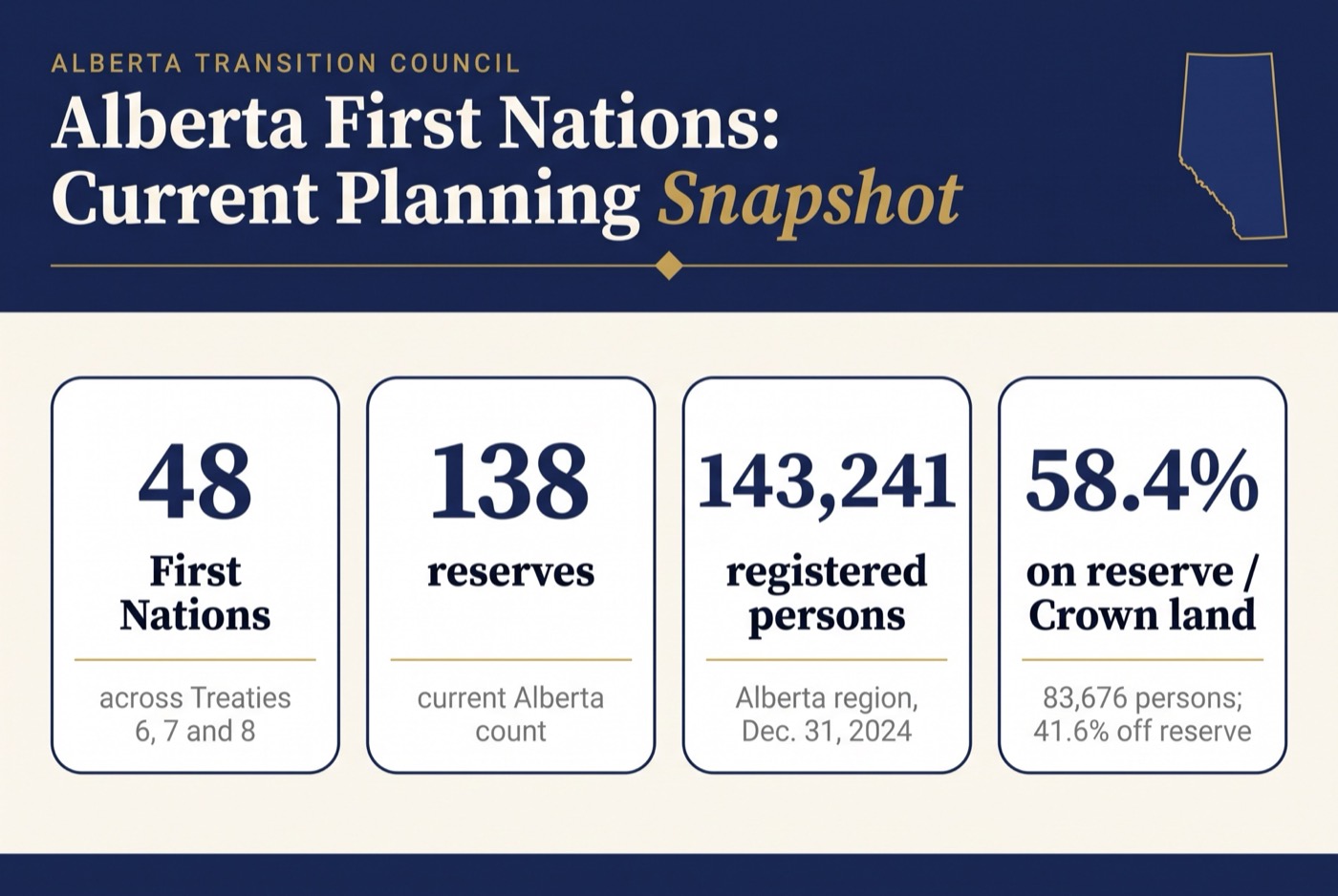
Alberta is home to 48 First Nations across Treaties 6, 7 and 8 and currently identifies 138 First Nations reserves. As of December 31, 2024, Indigenous Services Canada reported 143,241 people registered under the Indian Act in the Alberta region. Of those, 83,676, or 58.4%, were reported as living on reserve or Crown land, while 59,565, or 41.6%, lived off reserve.
The number of people living off reserve is important. First Nations rights, legal status and access to services affect people throughout Alberta, not only those who live on reserves.
Many services in First Nations communities are already delivered locally. First Nation governments and organizations manage housing, employ staff, operate community facilities, administer or participate in education and social programs, and carry out economic development.
The federal government nevertheless retains extensive legal, financial and administrative responsibilities. It provides the governing legislation, program funding, status records, reserve-land administration and certain specialized services. However, federal responsibility does not mean that federal officials directly deliver every service in every First Nations community. Many services are administered by First Nations themselves using federal funding or under federal legal frameworks.
Nor should continuity planning assume that the current federal system is working well. There are significant and longstanding concerns about federal funding, service delivery, infrastructure, land administration and the fulfilment of Crown and treaty obligations. The purpose of the transition should therefore be to preserve essential services and legal rights without automatically reproducing the problems of the existing system.
Under section 91(24) of the Constitution Act, 1867, Parliament currently has authority over “Indians, and Lands reserved for the Indians.” The Indian Act governs registration and status, reserve lands and certain governance matters. Legal title to most reserve land is held by the Crown for the use and benefit of the relevant First Nation. Indian Oil and Gas Canada administers and regulates oil and gas resources on First Nation reserve lands.
Alberta also already plays a major role. First Nations people use provincial health care, education, courts, policing, roads, environmental regulation and many other Alberta services although the division of responsibility may differ depending on the service, the person and whether the activity occurs on or off reserve. Alberta also has legal duties to consult First Nations when provincial decisions may affect protected Aboriginal or treaty rights.
Metis people have distinct rights and legal arrangements that must be considered separately. Alberta has eight Metis Settlements with their own protected land and governance system under Alberta law. The Metis Settlements General Council holds the fee-simple interest in Settlement lands. Settlement Councils, the provincial land registry and the Metis Settlements Appeal Tribunal already operate within Alberta’s legal system.
The easiest way to understand this chapter is to separate three categories:
Rights. Aboriginal and treaty rights are constitutional rights. They are not ordinary government programs and cannot simply be transferred, altered or discontinued as administrative matters.
Land and legal relationships. This includes reserve lands, Crown responsibilities and treaty relationships with individual First Nations.
Everyday services. This includes housing, health, education, public works, benefits and local administration.
All three must continue through a transition, but they do raise different legal and practical issues and cannot be addressed through a single transition mechanism.
Because each First Nation is a distinct rights-holder and treaty partner, one First Nation might choose to maintain a close relationship with Canada, while another might prefer Alberta assume particular functions under a negotiated agreements. One First Nation’s decision or agreement does not automatically apply to another.
For First Nations, the change may not be the service people see. It may instead be the legal and financial system behind that service.
The transition would need to determine a number of issues which include: Which government is responsible? Who manages reserve lands? Who maintains status records? Who funds programs? Who carries out treaty obligations? And what happens when Alberta’s current provincial boundaries become international boundaries?
Those questions cannot safely be answered by simply transferring every federal program or asset to Alberta. They would require direct negotiations with affected First Nations, as well as arrangements involving Alberta and Canada where their respective rights, obligations, lands, records or assets are engaged. Alberta’s duty to consult—and, where appropriate, accommodate—First Nations would continue to apply where transition decisions may adversely affect asserted or established Aboriginal or treaty rights.
For Metis peoples, the institutional change may be more limited because much of the Settlement land, registry, local government and legal system already exists under Alberta law. The priority would be to protect those systems and existing rights while any longer-term changes are negotiated.
12.1 The common Day 1 of independence rights guarantee
Every First Nation begins from the same basic protection: independence must not be used to reduce Aboriginal or treaty rights or interrupt essential services.
Existing rights, reserve interests, status records, harvesting rights, claims, court proceedings, program eligibility and services must continue until they are replaced by lawful negotiated agreements.
Treaty and Aboriginal rights themselves are not temporary transition arrangements. Aboriginal rights and the honour of the Crown do not simply expire because a transition period ends.
A non-derogation clause is simply a legal rule saying that nothing in the transition law may quietly reduce or weaken existing Aboriginal or treaty rights.
The transition plan will also distinguish between consultation and consent. For ordinary government decisions, existing legal rules about consultation and accommodation continue to apply. But where the transition contemplates a change to a First Nation’s own treaty relationship, reserve arrangements or the government responsible for important treaty functions, it is only the First Nation that can initiate and request that change.
This does not mean every existing government program must stay exactly the same forever. It means rights and services remain protected unless a First Nation seeks to negotiate a new arrangement.
12.2 Treaties 6, 7 and 8 and Crown responsibilities
Treaties 6, 7 and 8 were signed before Alberta became a province. Their terms are not identical, but they include matters such as reserve lands, annual payments, harvesting rights and other promises.
Modern Canadian law does not treat these treaties like ordinary business contracts. Courts consider the honour of the Crown, the historical circumstances, Indigenous understandings of the promises and the goal of reconciliation.
The 1930 Natural Resources Transfer Agreement is a useful example. Canada transferred control of most Crown lands and natural resources to Alberta, but reserves remained under federal administration and treaty harvesting rights were protected.
The lesson is important: government responsibilities can change while Indigenous rights continue to be protected and upheld.
That question would have to be dealt with directly in negotiations among Alberta, Canada and the affected First Nations.
12.3 Four First Nation-by-First Nation options
The transition plan should not assume that all 48 First Nations will want the same arrangement.
The starting point for every First Nation is the same: protect rights and keep services working. Beyond that, each First Nation should be able to negotiate the relationship it prefers through its own lawful decision-making process.
No option should be forced on a First Nation. A First Nation that needs more time or does not agree with a proposed arrangement is not “holding up” the transition. It is exercising its right to make its own decision. Each of these negotiations will be consent-based and paced by each First Nation rather than by Alberta’s project schedule.
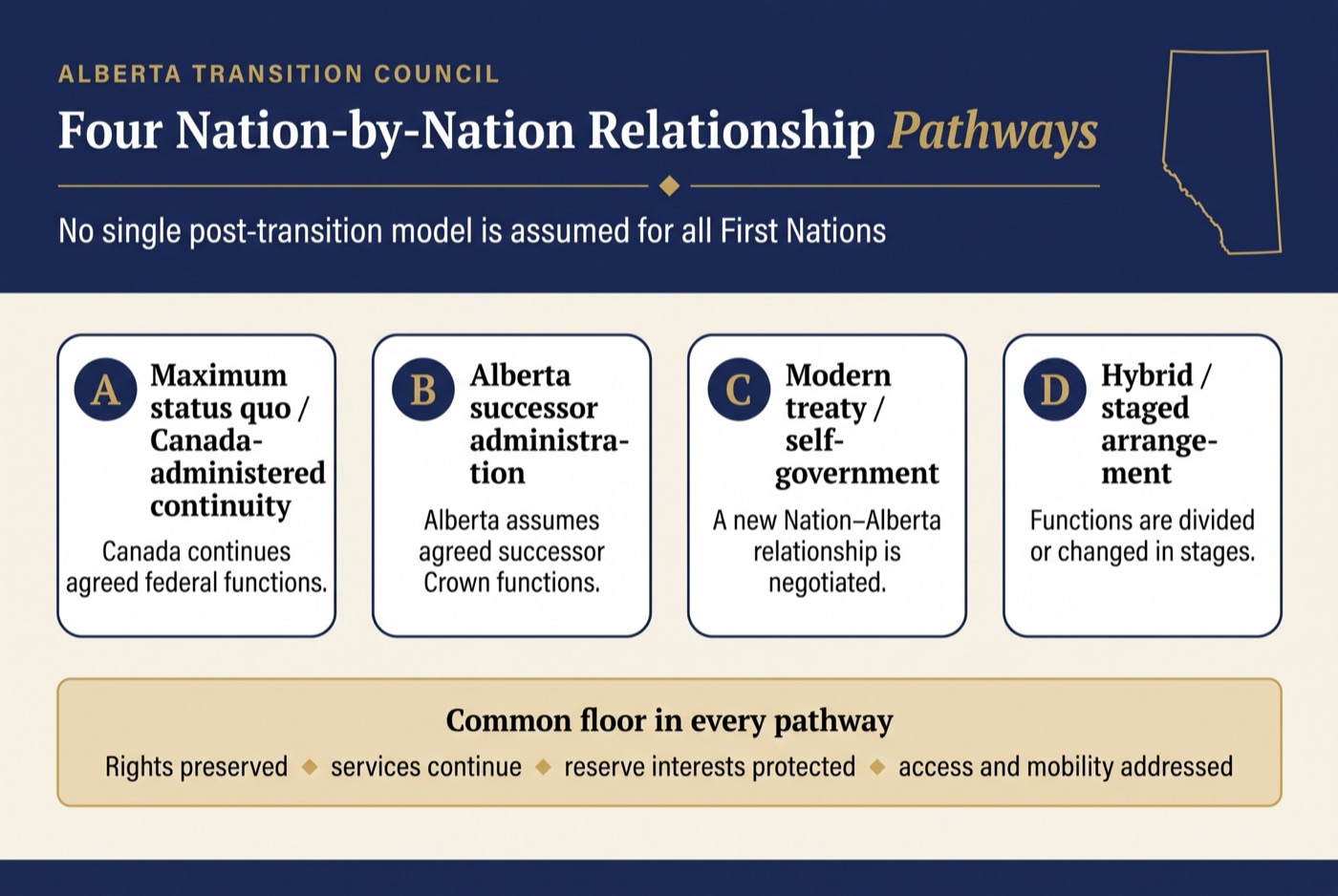
Option A — Keep the Canada relationship
A First Nation may want to keep its current relationship with Canada as much as possible.
That could include continued Indian Act administration, federal program funding, Indian status registration, Indian Oil and Gas Canada services and other federal arrangements.
But “nothing changes” would still require an agreement. Once Alberta becomes a separate country, Canada, Alberta and the First Nation would have to decide how federal services, access, borders and legal authority continue.
Canada could, for example, continue to own or administer certain reserve lands and services while the reserve remains inside Alberta.
A different possibility would be to negotiate that particular reserve territory remains Canadian territory. That would create additional questions involving borders, roads, policing, taxes, utilities and access.
Neither result would happen automatically.
Option B — Alberta takes over agreed federal functions
A First Nation may instead want Alberta to take over some functions that Canada performs today.
Canada, Alberta and the First Nation would agree on exactly which responsibilities move to Alberta and which remain with Canada.
Alberta would keep the familiar legal protections in place.
An Alberta First Nations Continuity Act could recognize existing Indian status, protect reserve interests, continue existing land and money rules, maintain current reserve tax treatment and protect Aboriginal and treaty rights.
Longer-term changes could be negotiated later if a First Nation requested.
Option C — A new treaty or self-government relationship with Alberta
Some First Nations may want to use the transition as an opportunity to move away from the Indian Act and negotiate a new relationship directly with Alberta.
A new agreement could deal with government powers, taxation, land management, services, resources, policing, courts and other matters.
The plan should not decide those terms in advance. They would be negotiated with the First Nation.
Any permanent agreement must also protect the First Nation against its terms being changed later by Alberta alone.
Option D — A mixed or gradual arrangement
A First Nation may prefer Canada to continue some services while Alberta handles others.
For example, Canada might continue status registration while Alberta funds certain infrastructure or education programs. Indian Oil and Gas Canada might continue operating while longer-term resource management arrangements are negotiated.
A First Nation might also simply want more time before making permanent choices.
A gradual approach allows decisions to be made after seeing how the new arrangements actually work.
The basic rule is simple: each First Nation decides through its own lawful process. Depending on the First Nation and the issue, that could involve Chief and Council, a community vote, traditional governance processes, Elders or another authorized body. Alberta should not create one voting rule for every First Nation.
12.4 Reserve lands: location, ownership and government control are different things
Reserve land is not the same as an ordinary federal building or piece of Crown land.
Under the current Indian Act, legal title is held by the Crown in trust for the use and benefit of the First Nation. The First Nation has a protected collective interest in that land.
Reserve lands should therefore never simply be placed into the general federal-assets category during Canada–Alberta negotiations.
The Day 1 rule should be simple: nothing automatically happens to reserve land merely because Alberta becomes independent.
No reserve, designated land, mineral interest or trust asset becomes Alberta property. It continues to be property held in trust for First Nations.
Legal title, territorial status, administration, minerals, roads, utilities and access should remain protected unless the affected First Nation requests a new arrangement.
The same applies to reserve oil and gas. Indian Oil and Gas Canada currently manages oil and gas on designated First Nation lands. It could continue temporarily, its staff and systems could move to a successor organization, or a First Nation could choose a different model.
First Nation reserve oil and gas continues as it is today and does not become Alberta Crown minerals.
12.5 How First Nation services work and what must continue
The best way to plan the transition is service by service.
If a First Nation already has a housing office, school, public works staff or health workers, there is usually no reason to replace them. The job is to make sure the funding, legal authority and records behind those services continue.
| Service | How it commonly works today | Day 1 goal |
|---|---|---|
| Housing | First Nation manages housing; Canada helps fund and finance it. | Keep the local housing system working and preserve funding and guarantees. |
| Community infrastructure | First Nation/local delivery with federal funding and provincial connections. | Keep funding, utilities, records and emergency coordination working. |
| Health | Alberta health system plus federal First Nations benefits and community programs. | Prevent gaps in benefits and community health funding. |
| Education | First Nation and provincial schools supported through different agreements and funding sources. | Keep schools open, students funded and records available. |
| Status / registration | Federal Indian Register and status-card system. | Keep existing status documents valid |
| Policing / justice | RCMP, First Nations policing, Alberta police and courts. | Keep police and justice services operating while long-term arrangements are negotiated. |
| Reserve oil and gas | Indian Oil and Gas Canada administers designated First Nation lands. | Keep leases, royalties, staff and systems working. |
For every service, the same practical questions should be asked: Who employs the staff? Who owns the building? Who has the records? Who pays? Which law authorizes the service? And where does someone go if there is a dispute?
A promise that “the service will continue” is not enough. The people, money, records and computer systems must actually be ready.
12.6 Status, identity and records
Records are critical.
The Indian Register, status records, First Nation membership or citizenship lists, land records, claims files and financial records all need to remain available.
It is also important to understand that Indian status and First Nation membership are not always the same thing. Indian status is a federal legal status under the Indian Act. First Nation membership or citizenship may be determined separately by the First Nation.
No one should have to prove their identity all over again because Day 1 arrived.
Before Day 1, Alberta and First Nations should have secure access to the records needed to continue services and protect rights. Existing status cards and records should remain usable while any new documents are introduced gradually.
12.7 Borders, mobility and the Jay Treaty context
If Alberta becomes independent, its current borders with British Columbia, Saskatchewan and the Northwest Territories would become international borders unless another arrangement is negotiated.
That matters because treaty territories, reserve lands, families, jobs, schools, health services and ceremonies often cross those boundaries.
First Nations mobility therefore needs special treatment.
The 1794 Jay Treaty is part of the history of Indigenous movement across the Canada–U.S. border. Today, however, the actual rules come from modern Canadian and U.S. laws.
U.S. law gives certain American Indians born in Canada a special right to cross the border if they meet the legal ancestry requirement.
Canadian law also gives every person registered as an Indian under the Indian Act the right to enter and remain in Canada.
The important point is that special Indigenous border rules already exist today.
Alberta should therefore create a broad right of entry and return for people registered under the Indian Act and people recognized under future First Nation citizenship arrangements.
Alberta and Canada should also negotiate an Indigenous Mobility Protocol dealing with travel, work, study, family visits, ceremonies, reserve access and recognition of identity documents.
Where treaty harvesting rights cross the new international boundary, a separate agreement may also be required.
The goal should be simple: movement that is routine today should remain as routine after independence.
12.8 Harvesting, consultation and land-use continuity
Existing treaty hunting, fishing, trapping and access rules should continue during the transition.
Alberta police and enforcement officers must receive clear instructions so that the constitutional change does not create confusion in the field.
Existing consultation files and commitments should also continue. They should not have to start again merely because Alberta’s constitutional status changes.
The same continuity principle applies to Metis harvesting and consultation systems.
12.9 Fiscal, tax and resource arrangements
First Nation taxation is different from ordinary Alberta taxation.
The current section 87 tax rules under the Indian Act, First Nation taxation powers, government funding, treaty annuities and reserve-resource royalties all require their own transition treatment.
The Day 1 objective is to prevent an unexpected change in taxes or funding.
The First Nations White Paper makes this especially clear: the transition plan does not propose changing the existing tax treatment of reserves simply because Alberta becomes independent. No new Alberta tax applying to reserves should appear indirectly or by accident.
Any future tax change affecting a First Nation should be dealt with openly through the proper legal and First Nation-specific process.
12.10 First Nations transition governance and decision rights
A First Nations Transition Secretariat should coordinate Alberta’s work, but it should not control First Nations.
Its job should be to organize negotiations, keep track of treaty and service issues, coordinate discussions with Canada and make sure other Alberta departments do not make decisions affecting First Nations without proper First Nation involvement.
First Nations should also receive reasonable funding for their own independent legal, financial and technical advice. Participation is not meaningful if a First Nation does not have the resources to review what is being proposed. Funded independent capacity is part of the transition structure.
There should be Treaty 6, Treaty 7 and Treaty 8 tables, as well as a separate table for each First Nation.
Treaty organizations may help coordinate common issues, but they should not automatically be assumed to speak for every First Nation.
Some decisions also cannot be made by Alberta alone. Questions such as reserve territory, transfer of federal responsibilities and new treaty or self-government arrangements may require agreement among Alberta, the affected First Nations and Canada.
The transition plan should therefore treat “not yet agreed” as a normal and manageable situation.
If a First Nation needs more time, existing rights and services should continue under a temporary arrangement. Alberta’s transition timetable should not force a First Nation to make a permanent choice before it is ready.
12.11 Metis rights, Settlement lands and governance
The Metis transition is different from the First Nations transition.
Much of the system already exists under Alberta law. Alberta’s eight Metis Settlements already have protected land, local governments, a land registry and a specialized appeal tribunal.
The approximately 1.25 million acres of Settlement land are not Indian Act reserves and should remain legally protected without requiring everyone to re-register their land.
At the same time, there is no single Metis organization that should automatically be assumed to represent every Metis person or community in Alberta.
The Metis Settlements and MSGC, the Otipemisiwak Metis Government, credibly asserted communities and other Metis organizations have different roles.
Existing memberships, citizenship records, harvesting recognition, consultation arrangements, legal proceedings and agreements should continue. Any major change should be negotiated with the Metis government or community that actually has the authority to make that decision.
Selected references from white papers
- Crown-Indigenous Relations and Northern Affairs Canada: Treaties 6, 7 and 8.
- Government of Canada: Indian Act, including ss. 2 and 18; Alberta Natural Resources Act / 1930 Natural Resources Transfer Agreement.
- Government of Canada: Constitution Acts, 1867 to 1982, including ss. 91(24), 25, 35 and 35.1.
- Supreme Court of Canada: Haida Nation v. British Columbia, 2004 SCC 73; Mikisew Cree First Nation v. Canada, 2005 SCC 69; R. v. Badger, [1996] 1 S.C.R. 771.
- Government of Alberta: Métis Relations; Métis Settlements; Métis harvesting rights; Indigenous consultation framework.
- Supreme Court of Canada: R. v. Powley, 2003 SCC 43; Alberta v. Cunningham, 2011 SCC 37; Daniels v. Canada, 2016 SCC 12.